Why structure matters
C₂H₄O₂ is not a unique structural description.
Other compounds can share the same atom counts. Acetic acid is identified by its particular connectivity and chemical structure, not by formula alone.
Acetic acid is the two-carbon carboxylic acid CH₃COOH. The –COOH group is the chemically decisive part of the molecule: it can donate a proton, leaving an acetate ion whose negative charge is stabilized by delocalization over two oxygen atoms.
The condensed formula CH₃COOH is more informative than C₂H₄O₂ because it shows the carbonyl and hydroxyl groups attached to the same carbon atom.
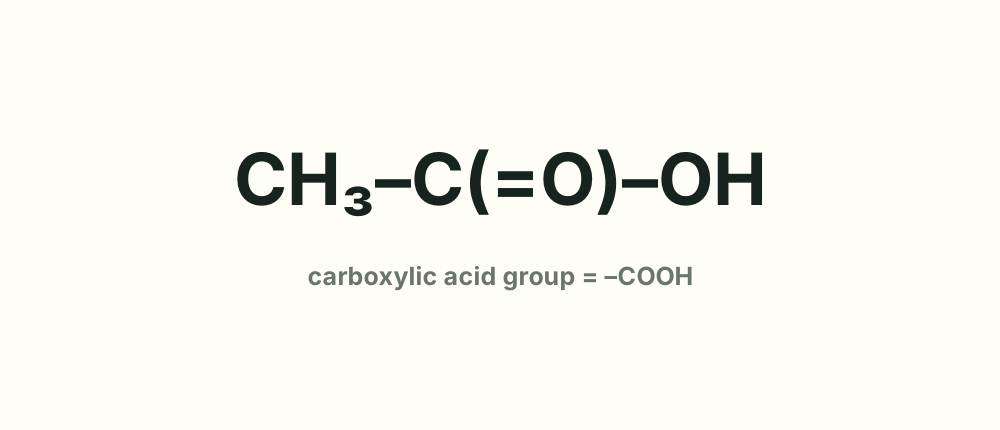
Other compounds can share the same atom counts. Acetic acid is identified by its particular connectivity and chemical structure, not by formula alone.
Acetic acid contains a methyl group attached to a carboxyl carbon. One oxygen is represented as carbonyl oxygen and the other as hydroxyl oxygen in the neutral molecule.
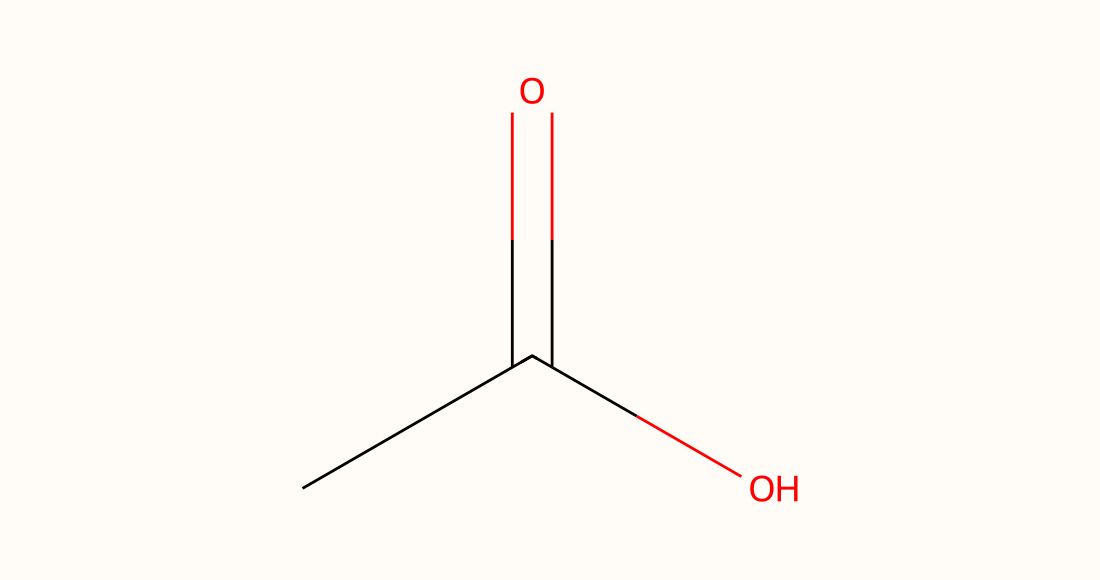
Removing it gives acetate, CH₃COO⁻. The C–H hydrogens on the methyl group are not the protons meant when acetic acid is described as a weak acid in water.
Acetic acid transfers a proton to water only partially, so the aqueous system contains an equilibrium mixture. The acetate ion has delocalized electron density over its two oxygen atoms, which stabilizes the conjugate base.
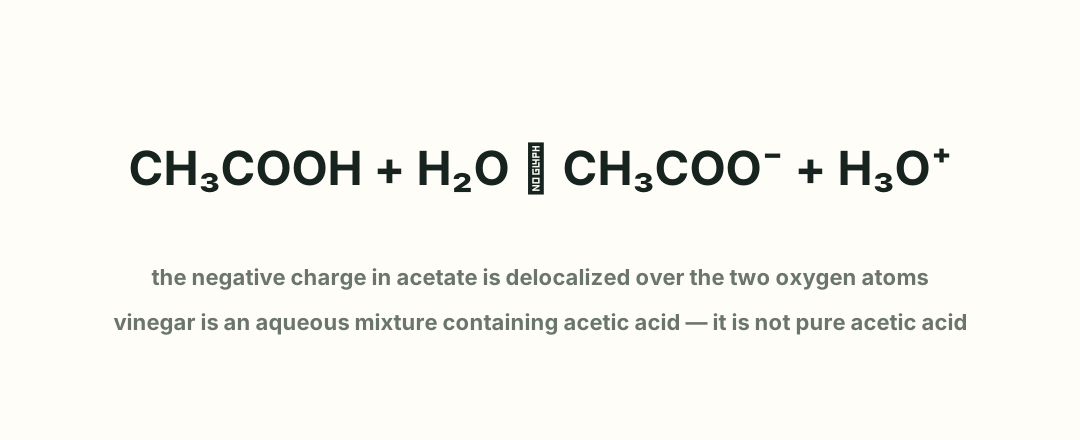
Recognizing conjugate acid–base pairs makes the equilibrium easier to read: acetic acid loses H⁺ while water gains it to become hydronium.
| Formula | C₂H₄O₂ / CH₃COOH |
|---|---|
| CAS Registry Number | 64-19-7 |
| PubChem CID | 176 |
| Standard InChI | InChI=1S/C2H4O2/c1-2(3)4/h1H3,(H,3,4) |
| Canonical SMILES | CC(=O)O |
A single Lewis structure localizes one C=O and one C–O⁻ bond, but resonance delocalizes electron density. The real ion is not rapidly switching between drawings; the resonance hybrid is the physical description.
No. Glacial acetic acid is a highly concentrated form of the compound, whereas vinegar is a dilute aqueous food mixture.
No. Acid strength describes equilibrium ionization, not hazard. Concentrated acetic acid can be corrosive.