Why the shape matters
The nitrogen lone pair is chemically active.
It influences the H–N–H bond angles and provides electron density that can accept a proton or coordinate to a Lewis acid.
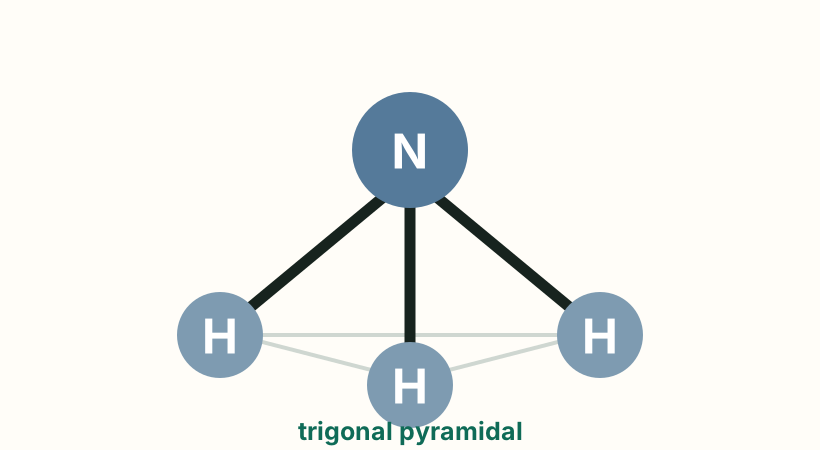
Ammonia is a molecular compound of nitrogen and hydrogen. Its nitrogen atom carries one lone pair, so NH₃ is trigonal pyramidal rather than flat. The same lone pair makes ammonia a Brønsted base and a Lewis base.
A simple 3D drawing shows the important fact first: three N–H bonds form a pyramid around nitrogen. The lone pair occupies the fourth electron-domain direction and changes both geometry and reactivity.
It influences the H–N–H bond angles and provides electron density that can accept a proton or coordinate to a Lewis acid.
Experimental gas-phase geometry places the H–N–H angle close to 106.7°. That value is smaller than the ideal tetrahedral angle because one of the four electron domains around nitrogen is a lone pair rather than a bond.
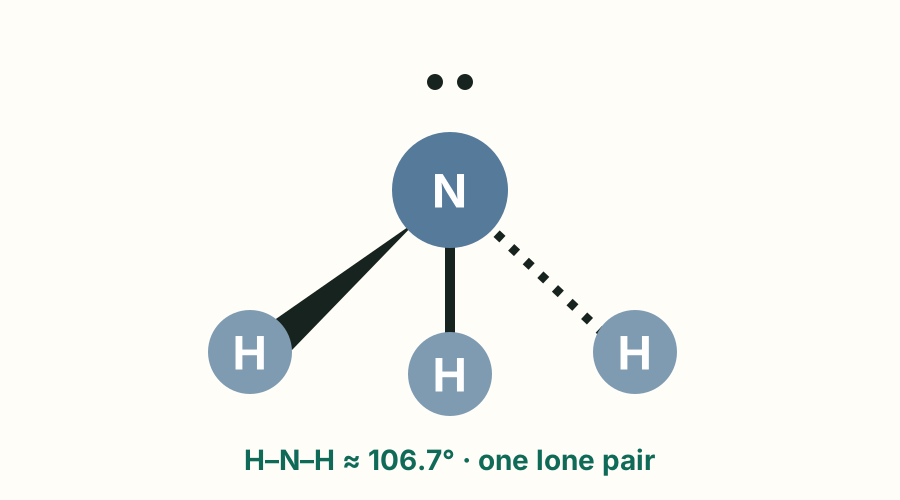
Four electron domains surround N, but only three are bonds to atoms. Molecular geometry names the positions of atoms, so the result is trigonal pyramidal.
The nitrogen lone pair can accept a proton from water. The equilibrium produces ammonium and hydroxide, but only a fraction of dissolved ammonia is protonated at ordinary concentrations.
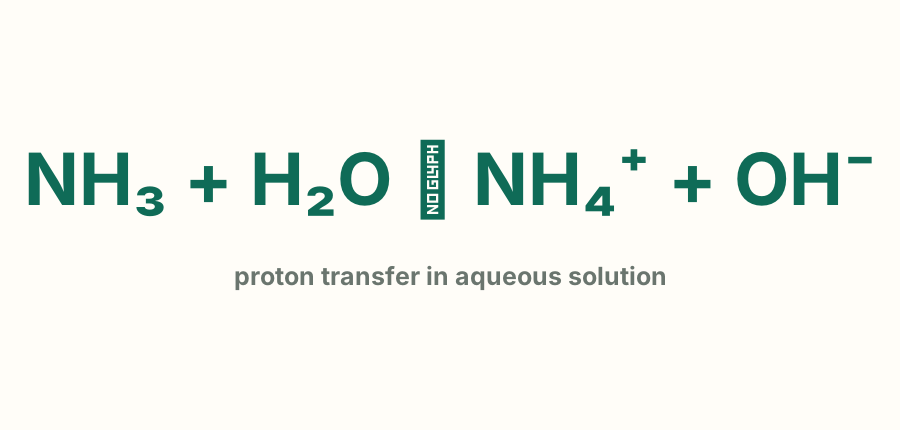
Ammonia is neutral and has a lone pair. Ammonium carries a +1 charge and has four N–H bonds; protonation changes geometry and chemical behaviour.
| Formula | NH₃ |
|---|---|
| CAS Registry Number | 7664-41-7 |
| PubChem CID | 222 |
| Standard InChI | InChI=1S/H3N/h1H3 |
Yes. N–H bonds can donate hydrogen bonds and the nitrogen lone pair can accept them. The interactions are generally weaker than the strong water–water hydrogen-bond network.
Writing NH₄OH as if it were a discrete molecular solute is misleading. Aqueous ammonia is better described by NH₃, H₂O, NH₄⁺ and OH⁻ connected by acid–base equilibrium.
The nitrogen lone pair can be donated to an electron-pair acceptor to form a coordinate bond.