Two bonding levels
Ionic between ions; covalent within carbonate.
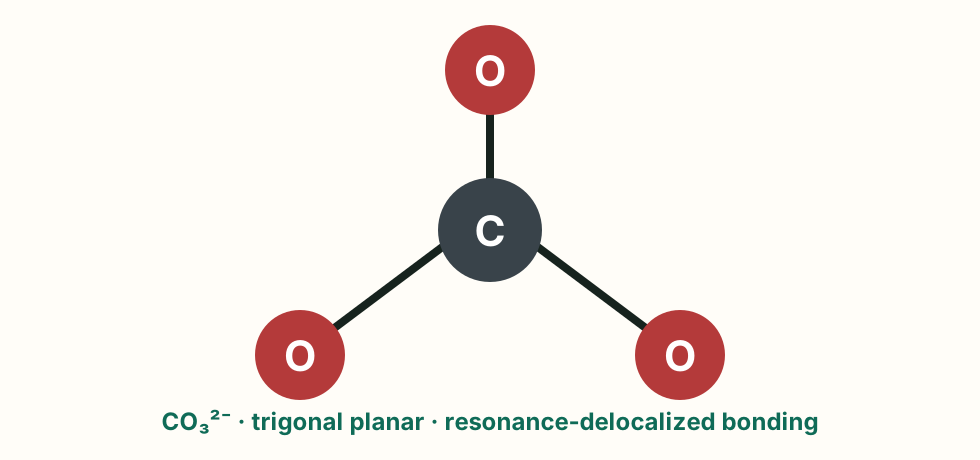
The C–O bonding inside CO₃²⁻ is covalent and delocalized. Interactions between Ca²⁺ and carbonate ions organize the extended crystal.
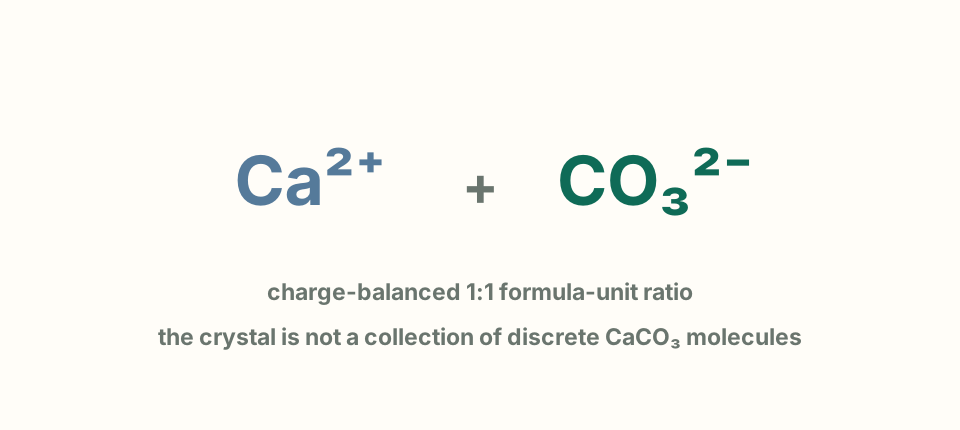
Calcium carbonate is an ionic solid composed of Ca²⁺ cations and CO₃²⁻ anions in a 1:1 ratio. The carbonate ion is internally covalent and resonance-delocalized, while the solid as a whole is an extended ionic crystal rather than a collection of discrete CaCO₃ molecules.
The simplest correct picture separates calcium ions from carbonate ions. There is no need to invent a covalent Ca–CO₃ molecule to explain the 1:1 stoichiometric ratio.
The C–O bonding inside CO₃²⁻ is covalent and delocalized. Interactions between Ca²⁺ and carbonate ions organize the extended crystal.
A single Lewis structure can draw one C=O and two C–O⁻ bonds, but the isolated carbonate ion is better understood through resonance: the three C–O positions are equivalent by symmetry.
Calcite and aragonite have the same chemical formula but different crystal structures. Formula alone therefore does not specify the complete solid-state arrangement.
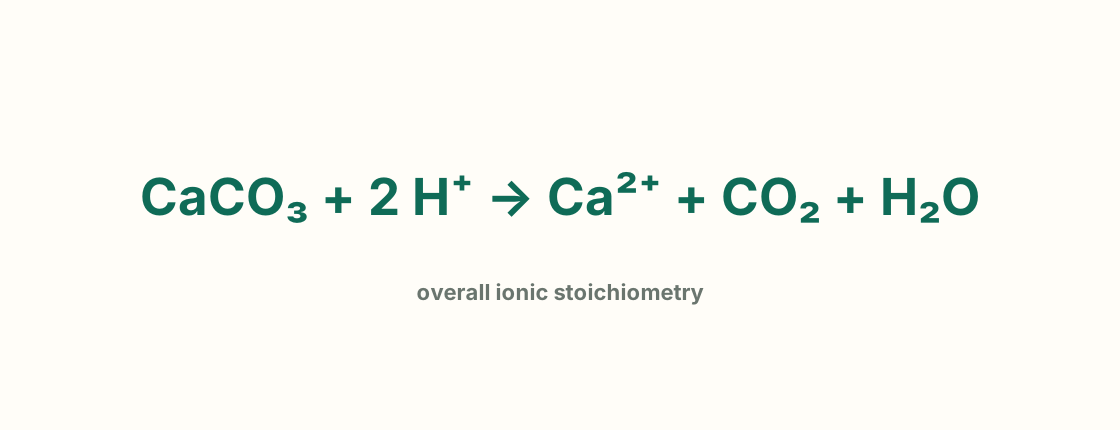
Carbonate consumes protons. The resulting carbonic-acid chemistry leads to CO₂ and H₂O, which is why carbonate minerals effervesce in acid.
Pure-water solubility is limited, but dissolved CO₂, pH and complexation can shift carbonate equilibria and change how readily calcium carbonate dissolves or precipitates.
| Formula | CaCO₃ |
|---|---|
| CAS Registry Number | 471-34-1 |
| PubChem CID | 10112 |
| Standard InChI | InChI=1S/CH2O3.Ca/c2-1(3)4;/h(H2,2,3,4);/q;+2/p-2 |
They have the same stoichiometric formula CaCO₃ but different crystal structures. They are polymorphs: different solid forms of the same composition.
No single conventional Lewis structure makes all three C–O positions equivalent. Resonance is a bookkeeping device for the delocalized electronic structure.
No. Natural and commercial materials can contain other minerals, water, organic matter or processing additives.