Mendeleev
Mendeleev / Compounds / Carbon monoxide
Molecular compound · carbon oxide

Carbon monoxide

CO

Carbon monoxide is CO, a neutral diatomic molecule containing one carbon and one oxygen. Its bond is unusually strong, and a naive electronegativity-only picture does not capture the full electron distribution.

Safety context: CO is toxic because it disrupts oxygen transport after binding strongly to hemoglobin.
Essentials

With only two atoms, CO is necessarily linear.

There is no bond angle to define in a diatomic molecule.
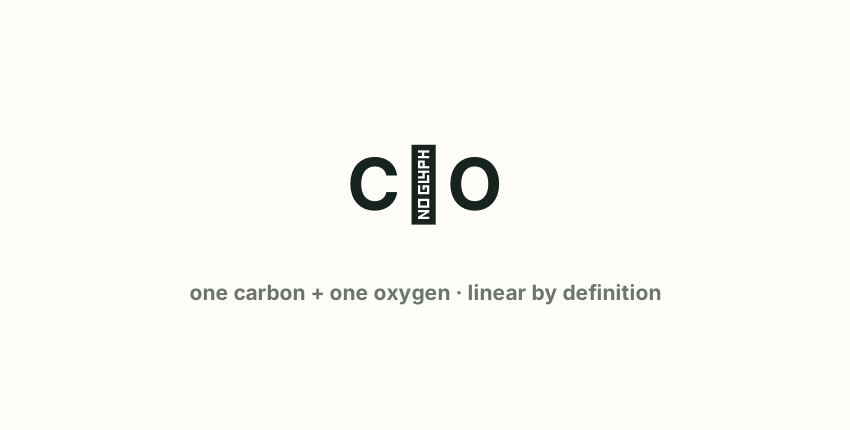
Carbon monoxide shown as C triple bond O
Beginner view: one carbon, one oxygen, one diatomic molecule.
CO ≠ CO₂

Adding another oxygen creates a different molecule.

Connectivity, electron count and chemistry all change.

Detail

Lewis bookkeeping commonly gives a triple bond with formal charges.

The formal-charge picture is useful for electron counting but is not a complete map of measured partial charge.
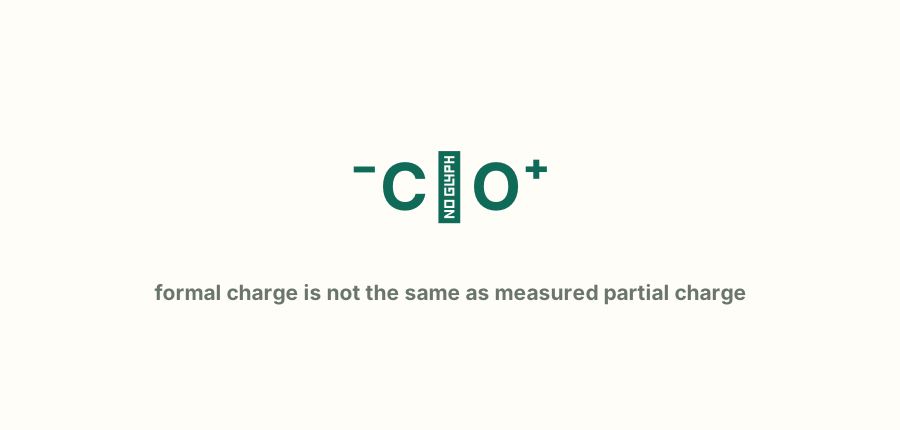
Lewis-style carbon monoxide with formal charges
Formal charge and partial charge are different concepts.
Subtle polarity

CO is a classic warning against an oversimplified electronegativity story.

Orbital contributions shape the small molecular dipole.

Read the formula

CO is a compact statement of composition.

Subscripts count atoms in the chemical molecule. Atom percentages and mass percentages answer different questions because the constituent elements have different atomic masses.

1 Ccarbon atom
1 Ooxygen atom

Percentages are calculated from standard relative atomic masses and rounded for display.

Understand

CO can be oxidized to carbon dioxide.

The balanced equation conserves atoms while the molecular connectivity changes.
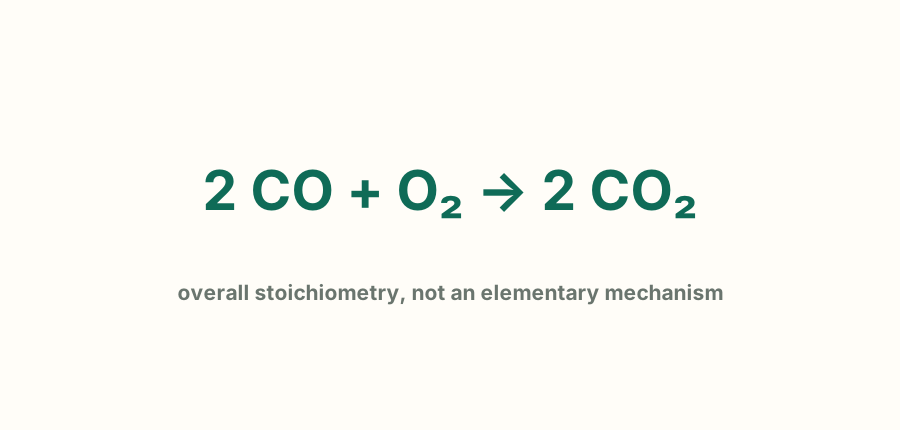
Balanced oxidation of carbon monoxide to carbon dioxide
Overall stoichiometry, not an elementary mechanism.
Combustion

CO can form under incomplete combustion conditions.

Real combustion involves radical networks and transport effects.

Reference identifiers

Names and identifiers that pin down the chemical identity.

FormulaCO
CAS Registry Number630-08-0
PubChem CID281
Advanced

Push past the first model without losing the simple picture.

Why draw C⁻ and O⁺?

That Lewis contributor satisfies octets; formal charge is bookkeeping, not a measured charge map.

Why can CO bind metals?

It can donate electron density to a metal and accept back-donation into antibonding orbitals.

Is CO half a CO₂ molecule?

No. It is its own stable molecular species.

Constituent elements

Connect the compound back to the periodic table.