Formula ≠ structure
C₂H₆O is not enough to identify ethanol uniquely.
Dimethyl ether has the same molecular formula but different connectivity. Structural formulas distinguish constitutional isomers that a molecular formula alone cannot.
Ethanol is a two-carbon alcohol with the structural formula CH₃CH₂OH. Its hydroxyl group gives the molecule a polar, hydrogen-bonding region while the two-carbon chain contributes a less polar hydrocarbon region.
The molecular formula C₂H₆O does not reveal which atoms are connected. Writing CH₃–CH₂–OH immediately exposes the hydroxyl functional group and the two-carbon skeleton.
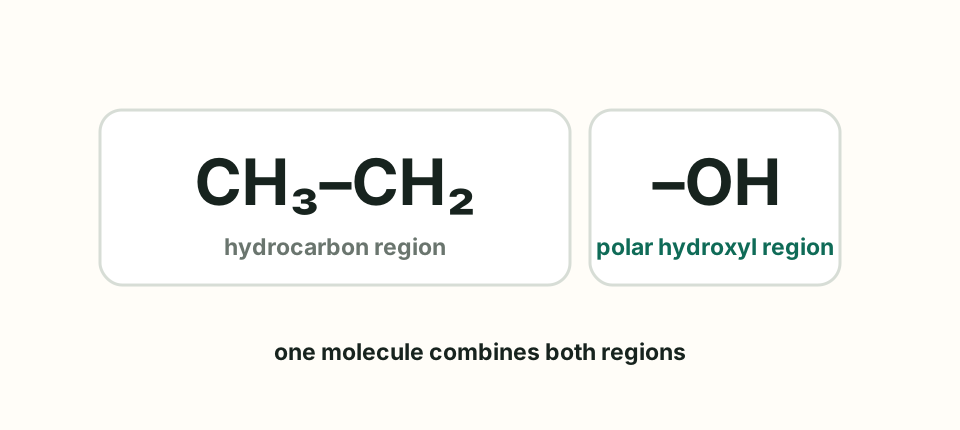
Dimethyl ether has the same molecular formula but different connectivity. Structural formulas distinguish constitutional isomers that a molecular formula alone cannot.
The carbon atoms are connected to each other, and the oxygen sits at the end of the chain as –OH. The O–H bond can donate hydrogen bonds, while oxygen's lone pairs can accept them.
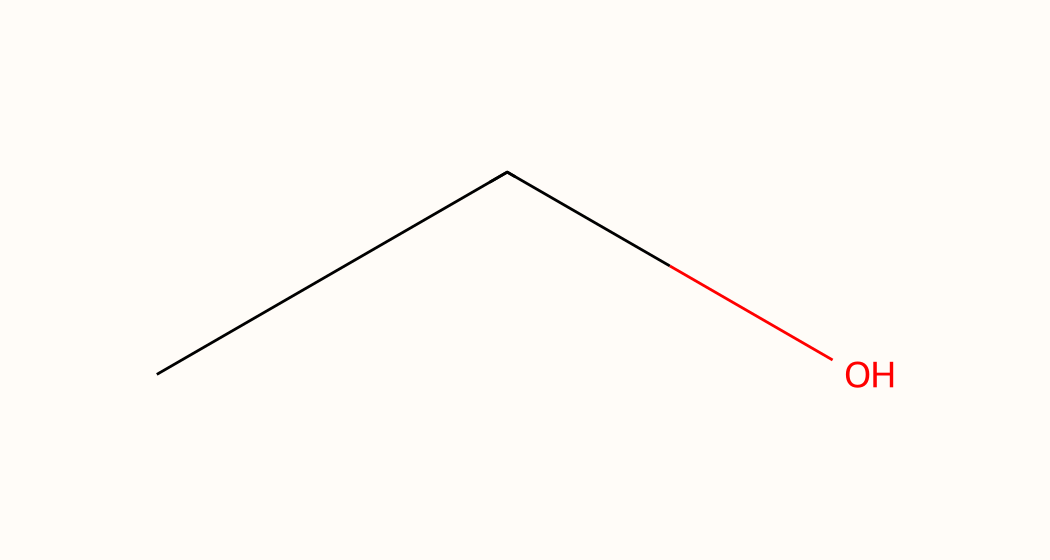
The hydroxyl end interacts strongly with polar environments, while the ethyl group behaves more like a small hydrocarbon. Ethanol's properties reflect both regions.
The hydroxyl group can both donate and accept hydrogen bonds. This is a major reason ethanol mixes with water much more readily than hydrocarbons of comparable size.
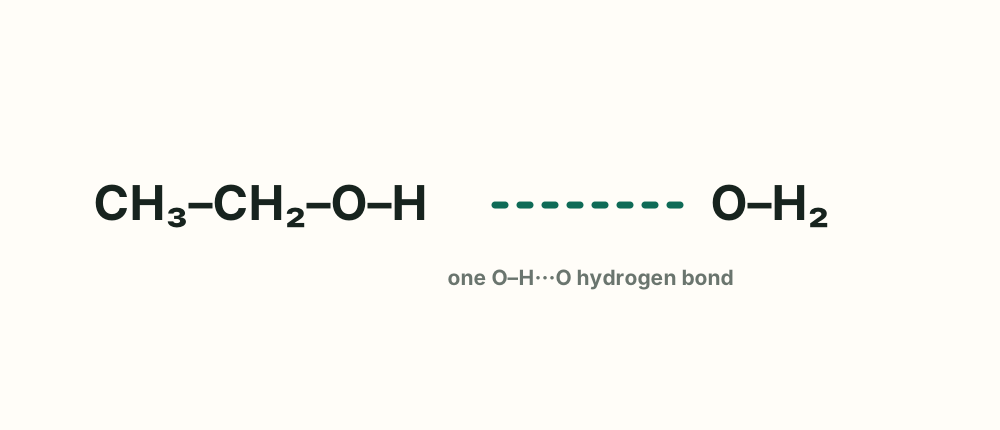
As the hydrocarbon part of an alcohol grows, its nonpolar contribution becomes increasingly important. Ethanol is small enough that the hydroxyl group strongly influences bulk miscibility.
| Formula | C₂H₆O / CH₃CH₂OH |
|---|---|
| CAS Registry Number | 64-17-5 |
| PubChem CID | 702 |
| Standard InChI | InChI=1S/C2H6O/c1-2-3/h3H,2H2,1H3 |
| Canonical SMILES | CCO |
Molecular formulas count atoms but do not encode connectivity. Dimethyl ether, CH₃–O–CH₃, is a distinct constitutional isomer.
Chemically pure ethanol is the compound itself. Real commercial grades can contain water; ethanol and water also form non-ideal mixtures, so composition must be stated separately from molecular identity.
The defining motif is an –OH group bonded to a saturated carbon atom. The oxygen alone is not enough; connectivity determines the functional class.