Double bond
Two bond components connect the same carbon pair.
A σ bond lies along the internuclear axis and a π bond arises from sideways orbital overlap.
Ethene is C₂H₄, the simplest alkene. Its two carbon atoms are connected by a double bond consisting of one σ bond plus one π bond.
H₂C=CH₂ is the simplest molecule that introduces a carbon–carbon π bond.
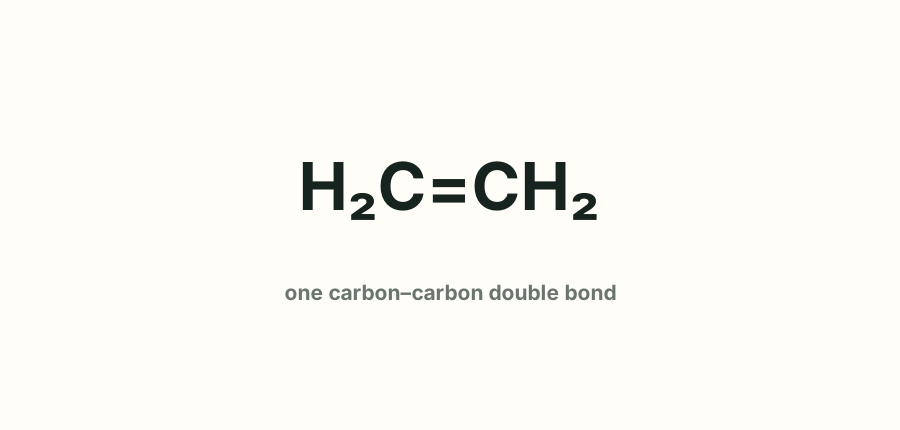
A σ bond lies along the internuclear axis and a π bond arises from sideways orbital overlap.
Both carbon centers are locally trigonal planar. Maintaining π overlap restricts free rotation around C=C.
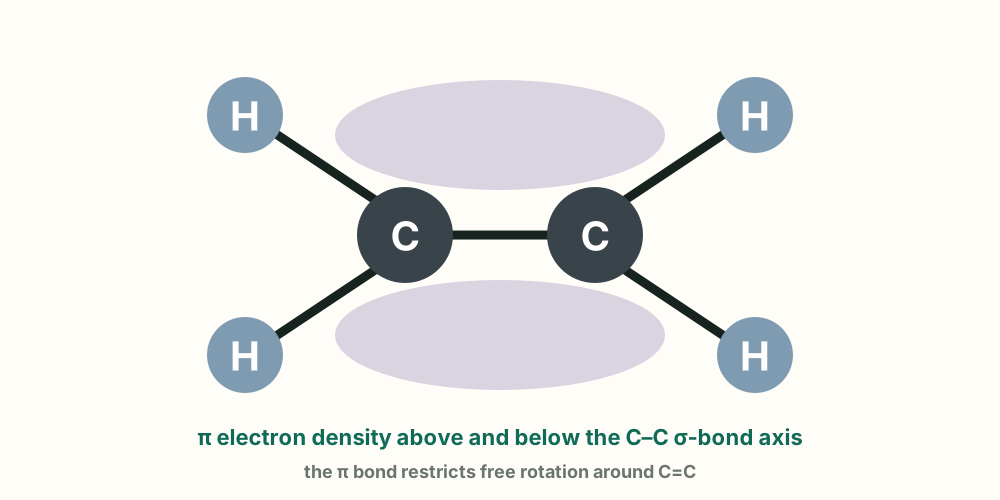
Twisting the carbons would weaken or break the orbital overlap responsible for the π bond.
Hydrogenation adds one H to each carbon and converts ethene into ethane. The overall change replaces a C=C double bond with a C–C single bond plus two new C–H bonds.
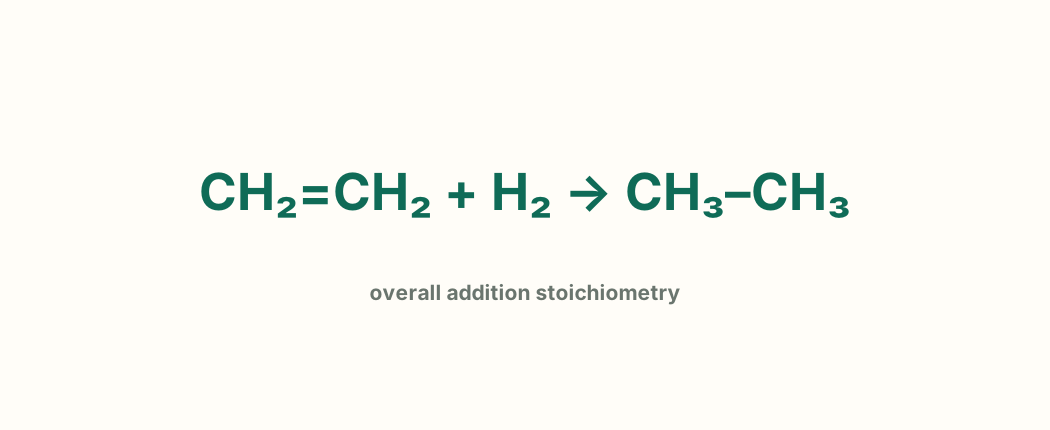
This makes the double bond a common site for addition chemistry.
| Formula | C₂H₄ / CH₂=CH₂ |
|---|---|
| CAS Registry Number | 74-85-1 |
| PubChem CID | 6325 |
Each carbon has a trigonal-planar sigma-bond framework while parallel p orbitals overlap to form the π bond.
Not freely. Rotation destroys the p-orbital overlap required for the π bond.
Yes. Ethylene is the retained/common name; ethene is systematic.