Aldehyde rule
The carbonyl carbon carries hydrogen.
That distinguishes formaldehyde from a ketone such as acetone, where carbon groups flank the carbonyl.
Formaldehyde is CH₂O, the simplest aldehyde. The carbonyl carbon is bonded to two hydrogens, giving H₂C=O as the defining molecular structure.
One carbonyl carbon is double-bonded to oxygen and bonded to two hydrogens. That makes formaldehyde the simplest aldehyde.
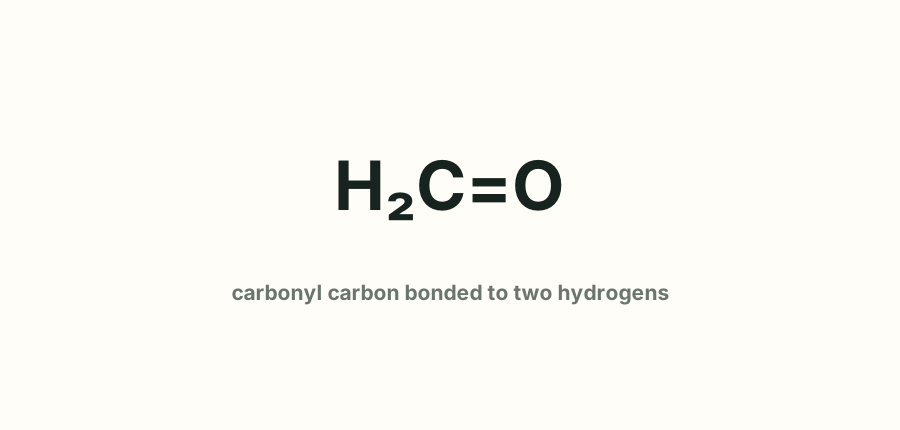
That distinguishes formaldehyde from a ketone such as acetone, where carbon groups flank the carbonyl.
Three electron-domain directions surround the carbonyl carbon: two C–H bonds and one C=O bonding axis. A flat 2D drawing therefore matches the local molecular geometry unusually well.

This polarization makes the carbonyl carbon electrophilic and the oxygen a hydrogen-bond acceptor.
Water can add reversibly across the carbonyl to form methanediol. Real aqueous formaldehyde therefore should not be imagined as only isolated H₂C=O molecules floating unchanged.
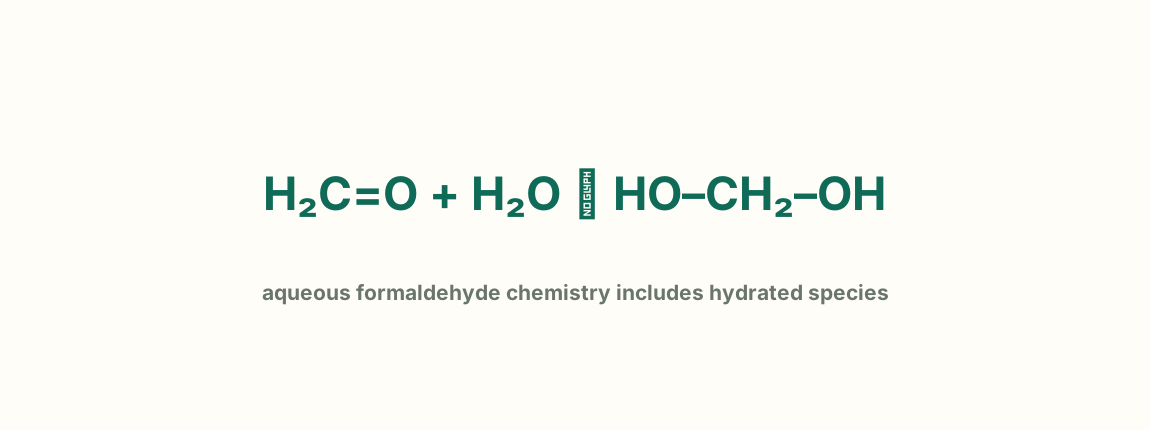
Concentration, water content and stabilizers belong to the product description, not to the molecular formula CH₂O.
| Formula | CH₂O |
|---|---|
| CAS Registry Number | 50-00-0 |
| PubChem CID | 712 |
No. Formaldehyde is CH₂O; formalin is an aqueous formulation containing formaldehyde-derived species.
Its small, strongly polarized carbonyl is highly accessible to nucleophilic water.
No. The formula counts atoms; the H₂C=O connectivity identifies the aldehyde structure.