Everyday language
A sugar
“Sugar” is broader than the white crystals on a kitchen table. Glucose, fructose and sucrose are all sugars, but they are not the same compound.
Glucose is a sugar and a monosaccharide. Chemically, it is an aldohexose: a carbohydrate with six carbon atoms and an aldehyde-derived carbonyl in its open-chain form. In water, D-glucose is found overwhelmingly as cyclic glucopyranose forms rather than as the open chain.
A monosaccharide is a carbohydrate that cannot be hydrolysed into a simpler carbohydrate. Glucose belongs to this class. “Aldohexose” adds two pieces of structural information: six carbon atoms, and an aldehyde function in the open-chain form.
“Sugar” is broader than the white crystals on a kitchen table. Glucose, fructose and sucrose are all sugars, but they are not the same compound.
One saccharide unit. Sucrose, by contrast, is a disaccharide made from glucose and fructose units linked together.
The open-chain representation has six carbons and an aldehyde at carbon 1. Ring formation converts that carbonyl into a cyclic hemiacetal.
The subscripts count atoms in one molecule. They do not tell you how those atoms are connected in space. Fructose has the same molecular formula as glucose but a different connectivity and carbonyl chemistry.
Names matter because formulas alone can hide structural differences.
An aldohexose. In water, D-glucose is mainly present as six-membered cyclic glucopyranose forms.
Same molecular formula, different structure. Fructose is a ketohexose rather than an aldohexose.
Table sugar. A glucose unit and a fructose unit are joined by a glycosidic bond.
No single flat drawing is “the molecule”. Each representation answers a different question. Start with Haworth for ring stereochemistry, then move to wedge–dash notation, the open chain and the α/β comparison.
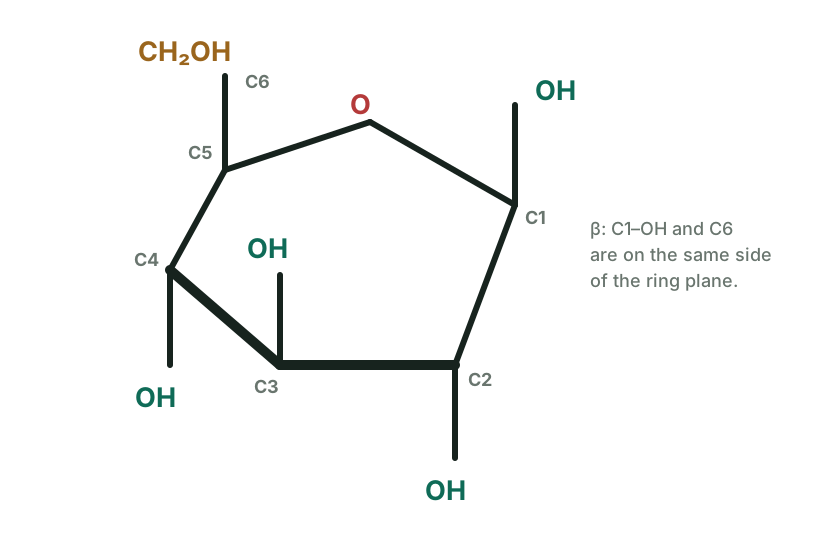
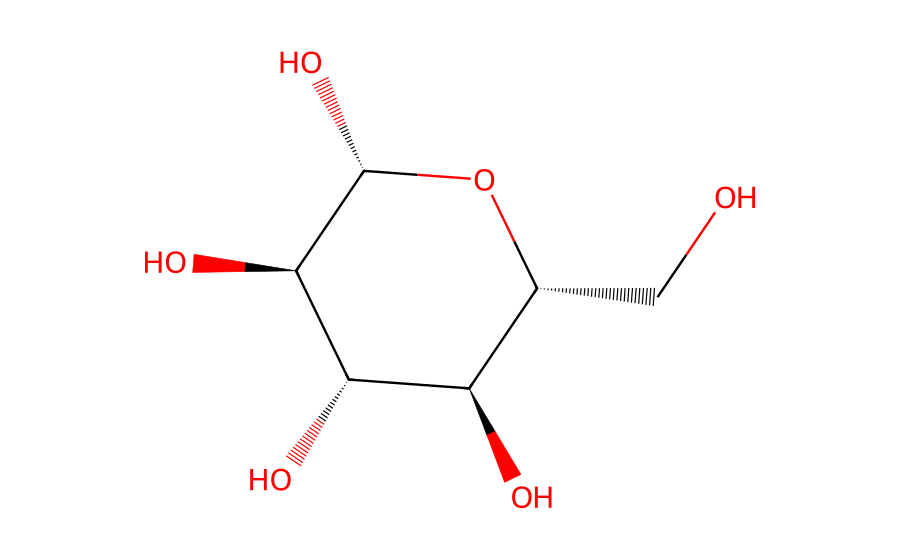
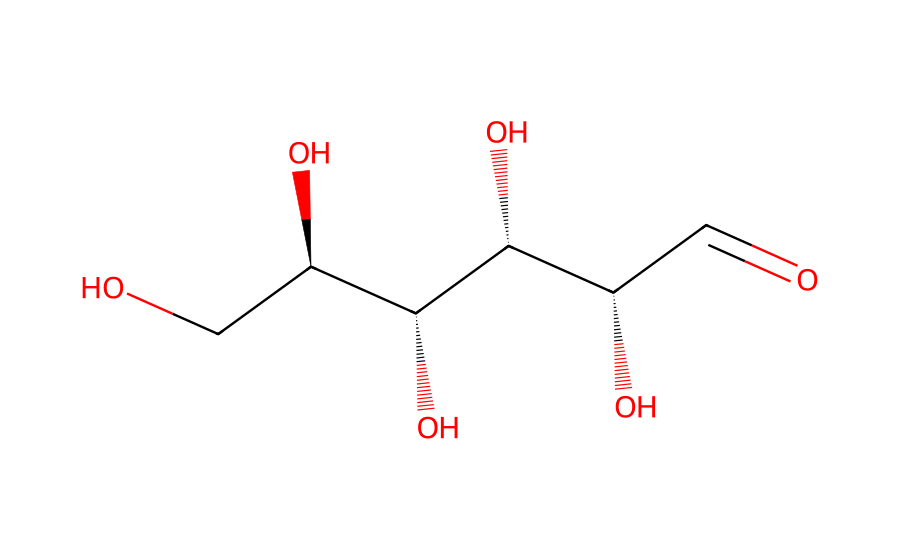
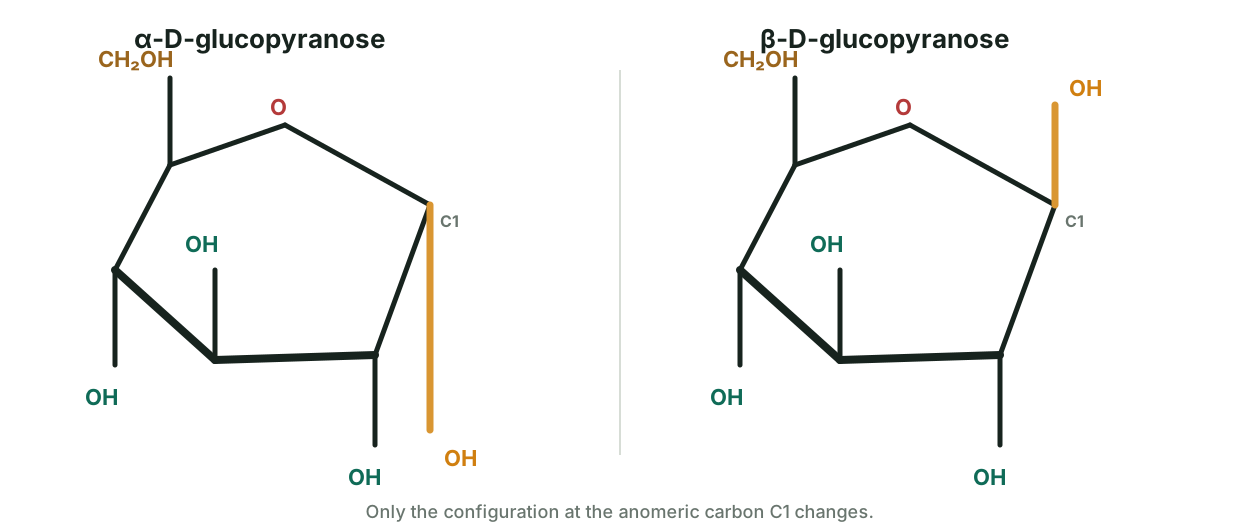
These are representative room-temperature values for the two major pyranose anomers, not universal constants. Published measurements vary slightly with conditions and method. Much smaller amounts of furanose and open-chain forms are also present.
Its behaviour follows from its functional groups, not simply from the formula C₆H₁₂O₆.
Solubility is a free-energy balance involving solute–water interactions, disruption of existing interactions and the solid state of the solute. The hydroxyl-rich structure strongly favours hydration, but crystal packing and temperature also matter.
Calling glucose simply “energy” hides the chemistry. Cells transform glucose step by step. Glycolysis is one pathway that begins its oxidation and conserves part of the available chemical free energy in molecules such as ATP and reduced cofactors. The subsequent fate of the carbon and electrons depends on the cell and conditions.
Light-driven reactions and carbon fixation generate intermediates that feed carbohydrate synthesis. Glucose units can later appear in sucrose, starch, cellulose and many other compounds.
These notes explain the chemistry behind the representations and the observations.
In the open-chain aldehyde, the hydroxyl group on C5 can attack the carbonyl carbon at C1 intramolecularly. The product is a six-membered cyclic hemiacetal. Ring closure creates a new stereogenic centre at C1: the anomeric carbon.
They differ only in configuration at the anomeric carbon. In the usual Haworth convention for D-glucose, the C5 CH₂OH group is drawn above the ring; the anomeric OH is below in α-D-glucopyranose and above in β-D-glucopyranose.
A pure α or β anomer dissolved in water does not keep a fixed optical rotation. The ring can open to the aldehyde and close again as either anomer, so the mixture approaches an equilibrium composition and the observed optical rotation changes with time.
Although the cyclic hemiacetal forms dominate, they remain in equilibrium with a small amount of open-chain aldehyde. Because the anomeric carbon is not locked in an acetal, glucose can access a form that is oxidised under standard reducing-sugar tests.
No. It is a projection. Six-membered glucopyranose rings adopt puckered conformations, with the chair form especially important. Haworth notation is retained because it makes relative stereochemistry easy to compare on a flat page.
Identifiers distinguish the substance from casual names and from structure-specific representations of individual anomers.
| Molecular formula | C₆H₁₂O₆ |
|---|---|
| Molar mass used here | 180.156 g/mol |
| Chemical class | Monosaccharide · aldohexose · carbohydrate |
| CAS Registry Number | 50-99-7 |
| PubChem CID | 5793 |
| Main aqueous forms | α-D-glucopyranose and β-D-glucopyranose; furanose and open-chain forms occur at much lower abundance |
Follow each constituent element back to its atomic structure and periodic behaviour.
The carbon skeleton carries the functional groups and stereocentres that define glucose.
Hydrogen appears in C–H bonds and in the hydroxyl groups central to glucose–water interactions.
Oxygen forms hydroxyl groups, the ring oxygen and the carbonyl oxygen of the open-chain form.