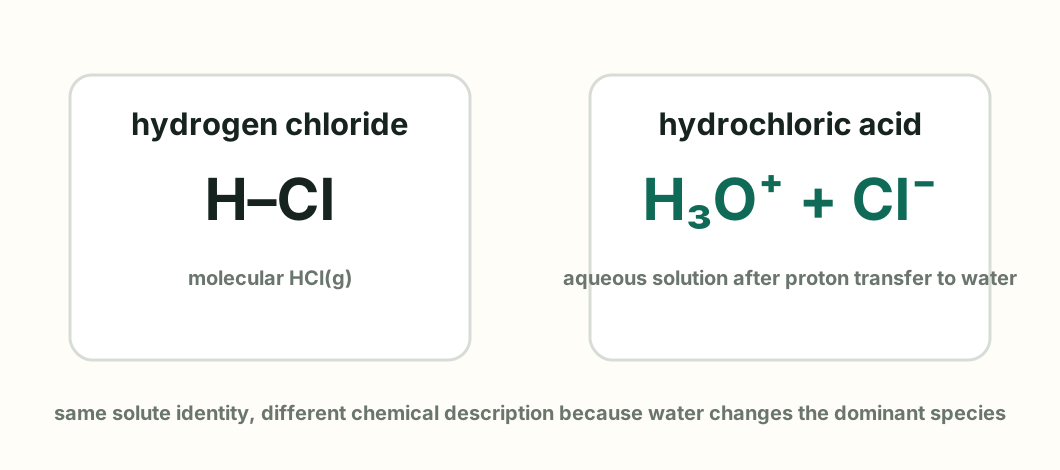
The compound stays HCl until water changes the dominant species.
Calling the pure molecular compound “hydrochloric acid” blurs the distinction between chemical identity and solution chemistry. The acid name belongs to the aqueous system.
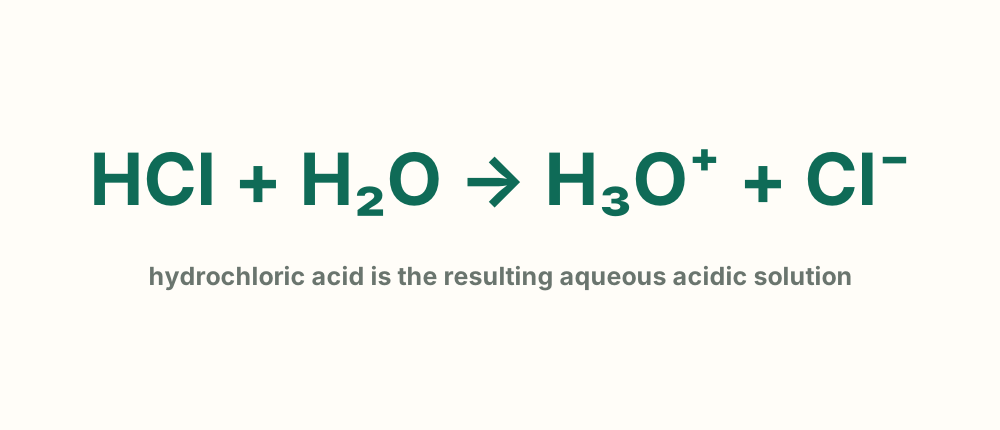
Hydrogen chloride is the molecular compound HCl. In the gas phase it exists as polar H–Cl molecules. When HCl dissolves in water, proton transfer to the solvent produces hydrochloric acid, an aqueous solution containing hydrated proton species and Cl⁻.
Hydrogen chloride contains one hydrogen atom covalently bonded to one chlorine atom. Chlorine attracts the bonding electron density more strongly, so the H–Cl bond is polar and the molecule has a permanent dipole.
Calling the pure molecular compound “hydrochloric acid” blurs the distinction between chemical identity and solution chemistry. The acid name belongs to the aqueous system.
When hydrogen chloride dissolves in water, proton transfer produces hydronium-type solvated proton species and chloride. In ordinary aqueous chemistry this reaction is treated as essentially complete, which is why the resulting hydrochloric acid is classified as a strong acid.
A dilute hydrochloric-acid solution can be less acidic in concentration terms than a concentrated solution of a weak acid. Strength and concentration answer different questions.
Once HCl has donated its proton to water, chloride remains as the conjugate base. Cl⁻ is a very weak Brønsted base in aqueous solution, consistent with hydrogen chloride producing a strong acid when dissolved in water.
It records the amount of hydrogen chloride added to water, but it should not be interpreted as saying that intact HCl molecules are the principal solute species in a dilute aqueous solution.
| Formula | HCl |
|---|---|
| CAS Registry Number | 7647-01-0 |
| PubChem CID | 313 |
| Molar mass of HCl | 36.46 g/mol |
| Names by context | HCl: hydrogen chloride · HCl in water: hydrochloric acid |
No. Hydrogen chloride is the compound HCl. Hydrochloric acid is the aqueous solution produced when HCl dissolves in water and transfers a proton to the solvent.
Records and labels can group names around the HCl chemical identity, but physical state and solvation matter chemically. Keeping “hydrogen chloride” for HCl and “hydrochloric acid” for the aqueous system avoids ambiguity.
No. H₃O⁺ is a compact chemical representation. Real aqueous proton solvation is dynamic and can involve larger hydrogen-bonded clusters.