Why the O–O bond matters
Peroxide chemistry is redox-active.
The oxygen atoms in peroxide have oxidation state −1 rather than the −2 typical of water. That makes disproportionation and other oxidation–reduction reactions possible.
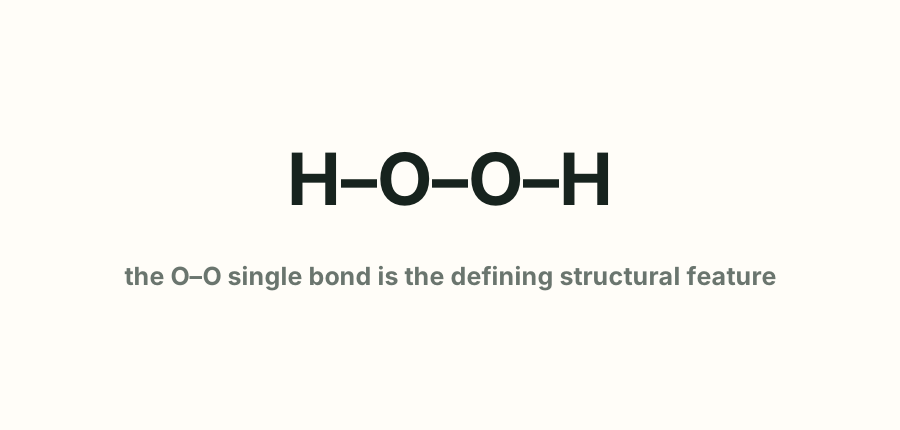
Hydrogen peroxide is H₂O₂, a molecular compound containing an oxygen–oxygen single bond. That O–O linkage distinguishes a peroxide from water and strongly influences its redox chemistry and tendency to decompose.
Writing H₂O₂ as just an empirical-looking formula can hide the connectivity. The structural skeleton H–O–O–H makes clear that the two oxygen atoms are directly bonded.
The oxygen atoms in peroxide have oxidation state −1 rather than the −2 typical of water. That makes disproportionation and other oxidation–reduction reactions possible.
Gas-phase hydrogen peroxide adopts a non-planar conformation around its O–O bond. A perspective drawing communicates that 3D fact without pretending one static 2D sketch captures the full torsional motion.
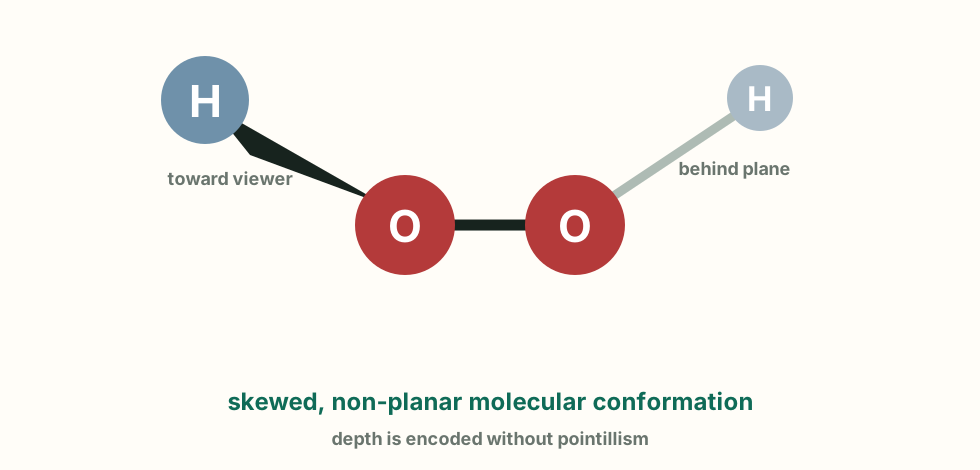
Molecules vibrate and rotate. The purpose of the perspective is only to show that the preferred geometry is non-planar.
The balanced overall equation conserves atoms and shows a disproportionation: peroxide oxygen ends in two different oxidation states, −2 in water and 0 in O₂.
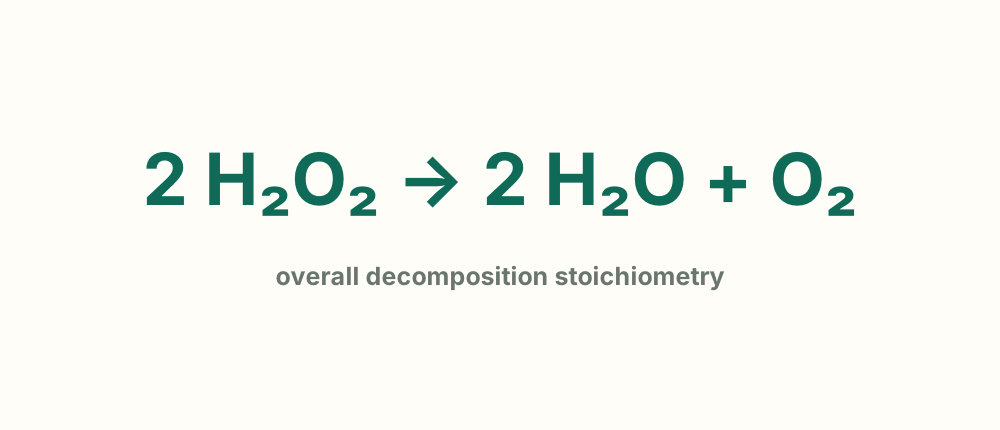
Reaction rate depends on activation barriers and catalytic pathways. Stabilizers and storage conditions are used because kinetics matter as much as the balanced equation.
| Formula | H₂O₂ |
|---|---|
| CAS Registry Number | 7722-84-1 |
| PubChem CID | 784 |
| Standard InChI | InChI=1S/H2O2/c1-2/h1-2H |
| Canonical SMILES | OO |
In an O–O bond the two identical oxygen atoms share electrons equally for oxidation-state bookkeeping. Each O also bonds to H, giving the peroxide oxygen an oxidation state of −1.
No. Depending on reaction partner and conditions, hydrogen peroxide can be either oxidized or reduced; its intermediate oxygen oxidation state enables both roles.
Concentration labels use a specified mass or volume convention, not a molecule-count percentage. The exact meaning depends on how the product concentration is defined.