Why geometry matters
Symmetry makes methane nonpolar overall.
Individual C–H bonds are only weakly polar. More importantly, the four equivalent bond directions are arranged so symmetrically that any bond-dipole contributions cancel.
Methane is the simplest hydrocarbon and the first member of the alkane family. One carbon atom forms four equivalent C–H bonds arranged tetrahedrally. The symmetry of that arrangement is central to methane's molecular properties.
A two-dimensional formula can hide three-dimensional geometry. Four bonding directions spread around carbon as a tetrahedron, giving methane a highly symmetric shape.
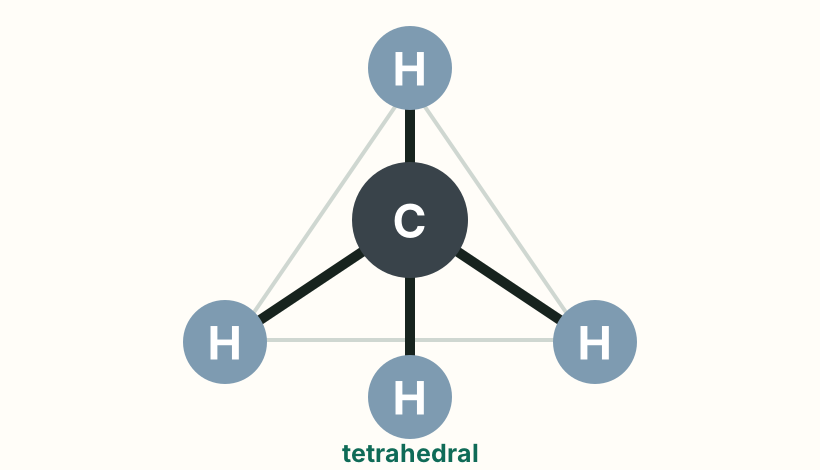
Individual C–H bonds are only weakly polar. More importantly, the four equivalent bond directions are arranged so symmetrically that any bond-dipole contributions cancel.
A tetrahedron places four equivalent directions as far apart as possible in three dimensions. For methane, all four C–H bonds are symmetry-equivalent and the H–C–H angles are the tetrahedral value.
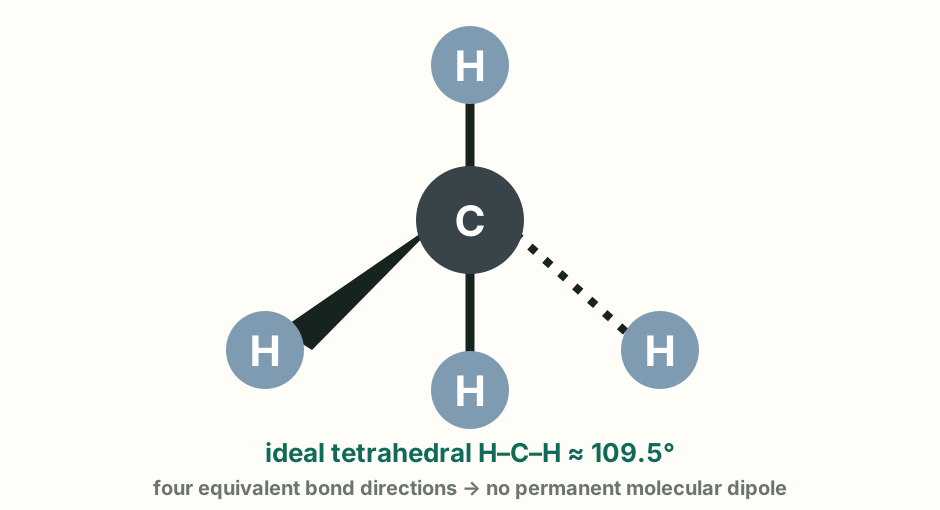
That helps explain its very low affinity for water and why its intermolecular attractions are dominated by dispersion forces.
In complete combustion, carbon ends in CO₂ and hydrogen ends in H₂O. The balanced equation is a conservation statement for atoms; it is not a claim that the reaction occurs in a single elementary collision.
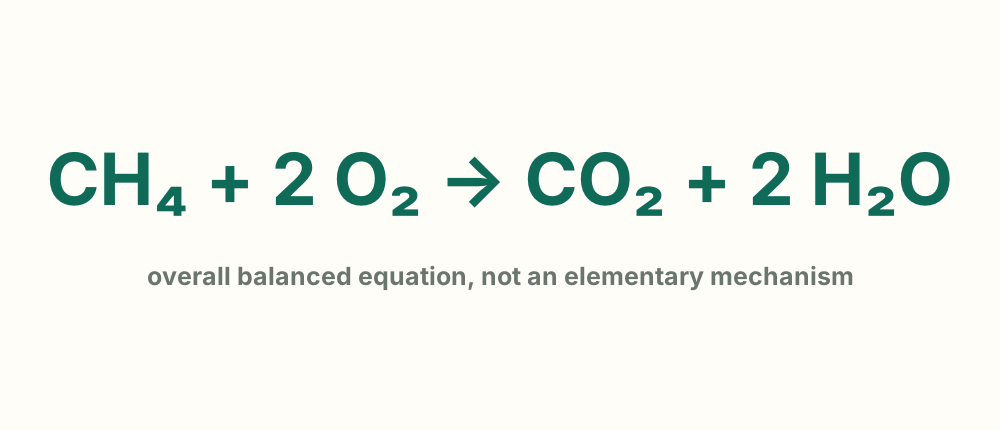
Bonds are broken and new bonds form. The products contain the same atoms reorganized into different molecules with different energies.
| Formula | CH₄ |
|---|---|
| CAS Registry Number | 74-82-8 |
| PubChem CID | 297 |
| Standard InChI | InChI=1S/CH4/h1H4 |
A localized bonding model describes four equivalent C–H sigma bonds directed tetrahedrally. More advanced orbital descriptions recover the same molecular symmetry without requiring four pre-existing directional atomic orbitals.
No. Natural gas is a variable mixture, commonly dominated by methane but also containing other hydrocarbons and non-hydrocarbon components.
No. Methane lacks a permanent dipole and is relatively unreactive under mild conditions, but it participates in combustion, radical halogenation and high-temperature chemistry.