Two bonding levels
Ionic between K⁺ and nitrate; covalent inside nitrate.
The N–O framework belongs to NO₃⁻.
Potassium nitrate is KNO₃, an ionic solid composed of K⁺ and NO₃⁻ ions. The nitrate ion is internally covalent and resonance-delocalized.
The 1:1 ratio balances +1 and −1 charge. Potassium is not covalently bonded into a little K–N–O₃ molecule.
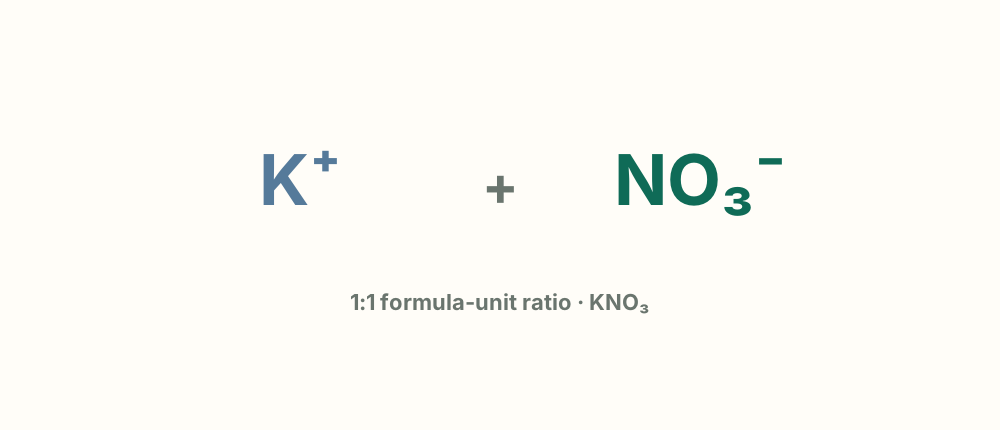
The N–O framework belongs to NO₃⁻.
A single Lewis contributor cannot make all three oxygen positions equivalent. Resonance captures the delocalized electronic structure.

Solid-state packing and temperature-dependent crystal forms add information beyond the formula.
Dissolution separates the ionic lattice into mobile solvated ions. The nitrate ion remains a polyatomic unit rather than breaking into nitrogen and oxygen atoms.
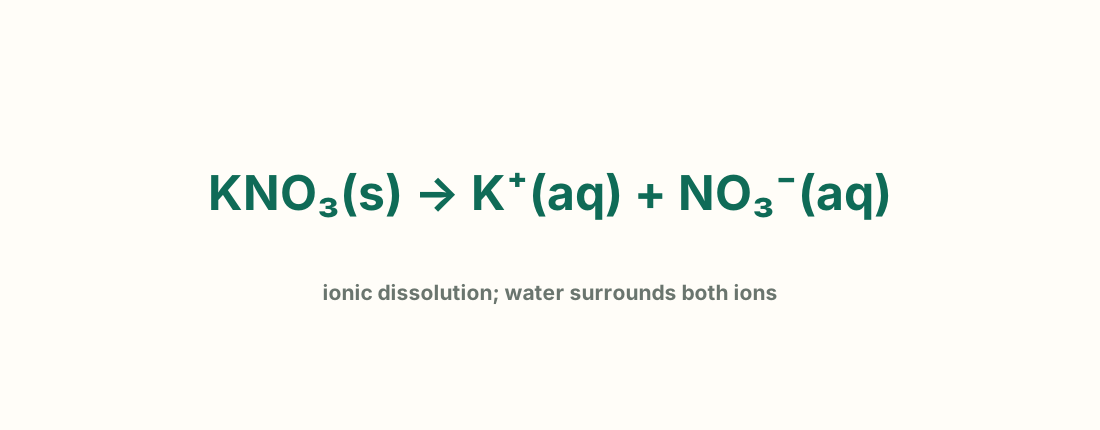
That does not mean they are chemically nonexistent; it means they may remain unchanged in a particular net ionic equation.
| Formula | KNO₃ |
|---|---|
| CAS Registry Number | 7757-79-1 |
| Ions | K⁺ and NO₃⁻ |
It is a polyatomic ion with covalent internal bonding, embedded in an ionic solid.
Resonance and trigonal symmetry delocalize the bonding over three oxygen positions.
No. Oxidizing ability describes possible redox behavior; actual reaction requires suitable partners and conditions.