Polyatomic ion
The covalent bonding is inside HCO₃⁻.
Carbon, oxygen and hydrogen are covalently connected within the hydrogen carbonate ion. Sodium belongs to the ionic lattice as Na⁺.
Sodium bicarbonate is an ionic compound made from Na⁺ and HCO₃⁻ ions in a 1:1 ratio. The hydrogen carbonate ion can both accept and donate a proton, which gives bicarbonate chemistry its buffering and acid-reactive behaviour.
The formula unit balances one +1 sodium ion with one −1 hydrogen carbonate ion. Keeping the polyatomic ion intact prevents the common mistake of drawing a covalent Na–O bond as though the compound were molecular.
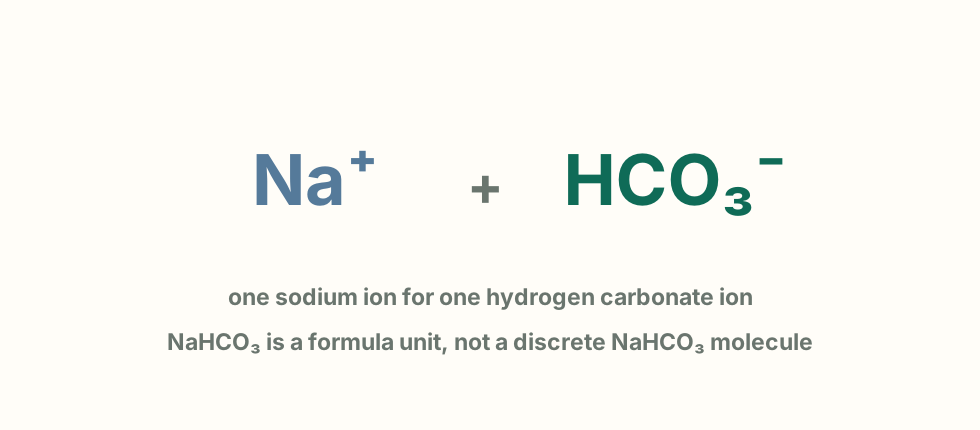
Carbon, oxygen and hydrogen are covalently connected within the hydrogen carbonate ion. Sodium belongs to the ionic lattice as Na⁺.
HCO₃⁻ sits between carbonic acid and carbonate in a proton-transfer sequence. It can accept H⁺ to form H₂CO₃-related species or donate H⁺ to form CO₃²⁻, depending on the environment.
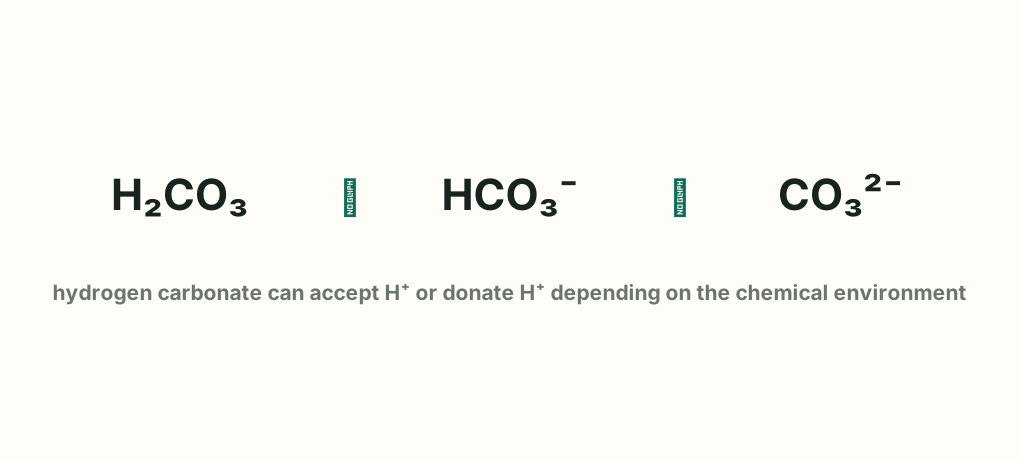
Which direction dominates depends on pH, concentrations, dissolved CO₂ and the other acid–base partners present.
A proton converts hydrogen carbonate toward carbonic-acid chemistry, and CO₂ plus H₂O are formed. Escape of gaseous CO₂ helps drive the visible fizzing.
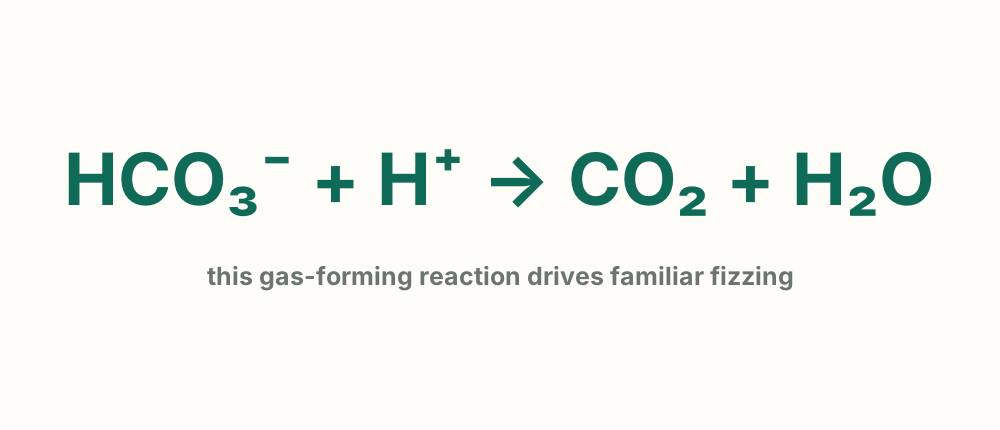
In a formulation, an acid source reacts with bicarbonate to generate CO₂ bubbles. The complete food system is much more than pure NaHCO₃ alone.
| Formula | NaHCO₃ |
|---|---|
| CAS Registry Number | 144-55-8 |
| PubChem CID | 516892 |
| Standard InChI | InChI=1S/CH2O3.Na/c2-1(3)4;/h(H2,2,3,4);/q;+1/p-1 |
| Canonical SMILES | C(=O)(O)[O-].[Na+] |
Both names are widely encountered. Hydrogen carbonate makes the presence of one acidic hydrogen explicit and aligns directly with the formula HCO₃⁻.
Not as discrete H₂CO₃ molecules in the solid formula unit. The anion is HCO₃⁻; carbonic acid appears in related protonation equilibria.
It has one removable proton but also carries negative charge and electron density capable of accepting a proton.