Mendeleev
Mendeleev / Compounds / Sodium carbonate
Ionic solid · carbonate salt

Sodium carbonate

Na₂CO₃

Sodium carbonate is Na₂CO₃, an ionic solid made from Na⁺ and CO₃²⁻ ions. Two sodium ions are required for each carbonate ion to balance charge.

Hydrate distinction: sodium carbonate can occur in hydrated crystal forms. This master describes the anhydrous composition Na₂CO₃ unless a hydrate is named explicitly.
Essentials

Na₂CO₃ is two Na⁺ ions for one CO₃²⁻ ion.

The formula unit is charge-balanced. It should not be drawn as one six-atom covalent molecule.
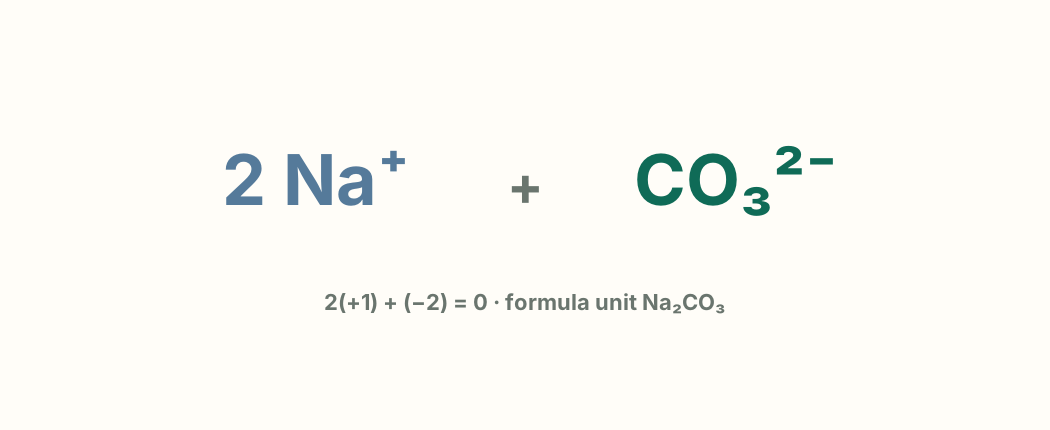
Two sodium ions and one carbonate ion shown as the charge-balanced components of sodium carbonate
Beginner view: ionic stoichiometry first.
Two bonding levels

Ionic between sodium and carbonate; covalent inside carbonate.

The C–O framework belongs to the polyatomic ion.

Detail

The carbonate ion is trigonal planar and resonance-delocalized.

A single Lewis contributor cannot make all three C–O positions equivalent. Resonance is the correct bookkeeping language for the isolated carbonate ion.
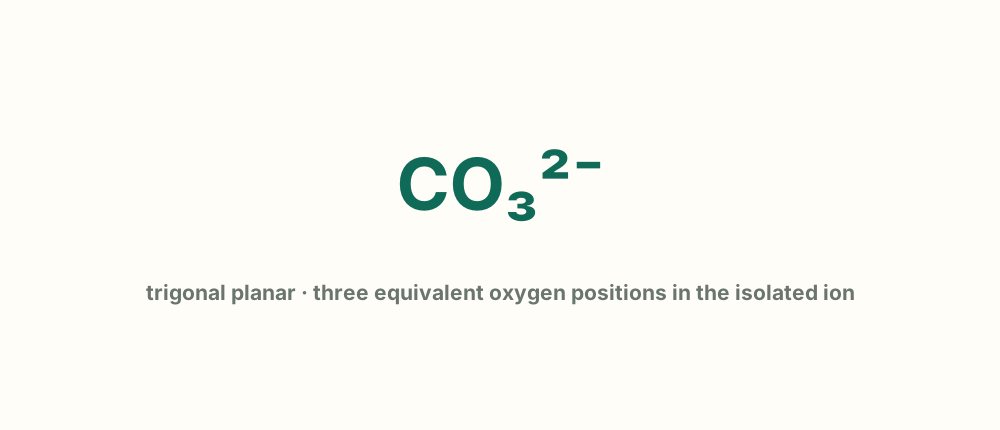
Carbonate ion labeled trigonal planar and resonance-delocalized
Detail view: the polyatomic ion keeps its own internal covalent structure.
Do not invent Na–O molecules

Sodium ions belong to the extended ionic solid.

The formula records composition, not a discrete molecular geometry for Na₂CO₃.

Read the formula

Na2CO3 is a compact statement of composition.

Subscripts count atoms in the chemical formula unit. Atom percentages and mass percentages answer different questions because the constituent elements have different atomic masses.

2 Nasodium atoms
1 Ccarbon atom
3 Ooxygen atoms

Percentages are calculated from standard relative atomic masses and rounded for display.

Understand

Acid converts carbonate into carbon dioxide and water.

Protons consumed by carbonate ultimately give CO₂ and H₂O, which explains effervescence when carbonate contacts acid.
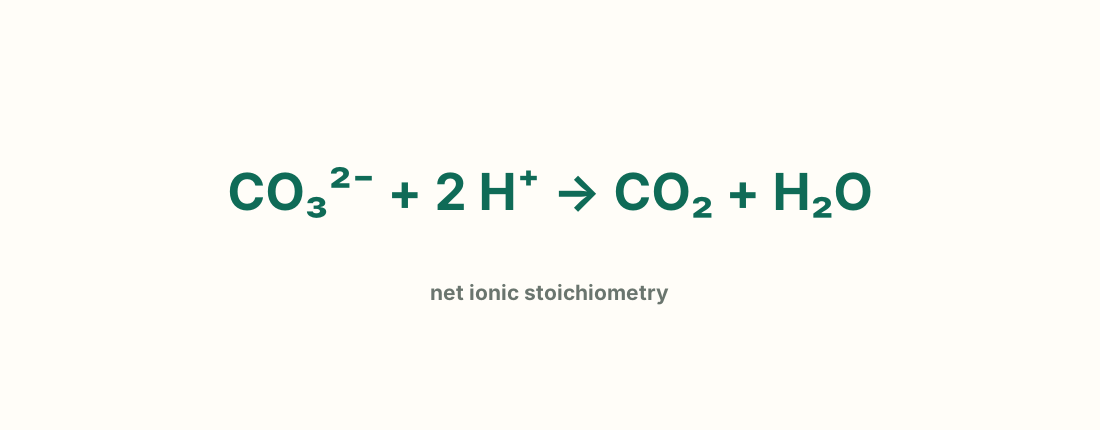
Carbonate plus two protons gives carbon dioxide and water
Net ionic chemistry isolates the carbonate reaction from spectator ions.
Compare bicarbonate

CO₃²⁻ and HCO₃⁻ differ by one proton and one charge unit.

Sodium carbonate and sodium bicarbonate are therefore distinct compounds with different stoichiometry and acid–base behavior.

Reference identifiers

Names and identifiers that pin down the chemical identity.

FormulaNa₂CO₃
CAS Registry Number497-19-8
Form representedanhydrous sodium carbonate
Advanced

Push past the first model without losing the simple picture.

Is sodium carbonate a molecule?

No. In the solid it is an extended ionic material represented by formula units.

Why are three C–O positions equivalent in carbonate?

Resonance and trigonal symmetry delocalize the bonding across the three oxygen positions.

Is washing soda the same formula as anhydrous sodium carbonate?

Not necessarily. Washing soda commonly refers to hydrated sodium carbonate, so the water of crystallization must be specified.

Constituent elements

Connect the compound back to the periodic table.