Inside hydroxide
The O–H bond belongs to OH⁻.
Hydroxide is a covalently bonded diatomic ion carrying −1 charge. Sodium interacts ionically with the anion in the solid.
Sodium hydroxide is an ionic solid made from Na⁺ and OH⁻ in a 1:1 ratio. In water it separates into solvated ions, making hydroxide directly available for acid–base reactions. Its dissolution is strongly exothermic.
The formula unit expresses electrical neutrality. Sodium is present as Na⁺ and hydroxide as the polyatomic anion OH⁻; drawing a covalent bond from Na to O would give the wrong first mental model.
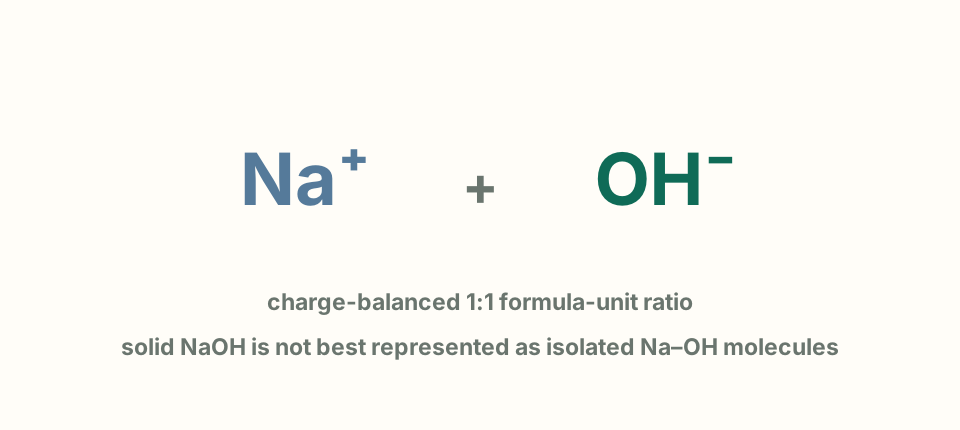
Hydroxide is a covalently bonded diatomic ion carrying −1 charge. Sodium interacts ionically with the anion in the solid.
Sodium hydroxide is a strong electrolyte. The chemically important base species is hydroxide, while sodium acts mainly as a spectator ion in many simple aqueous acid–base reactions.
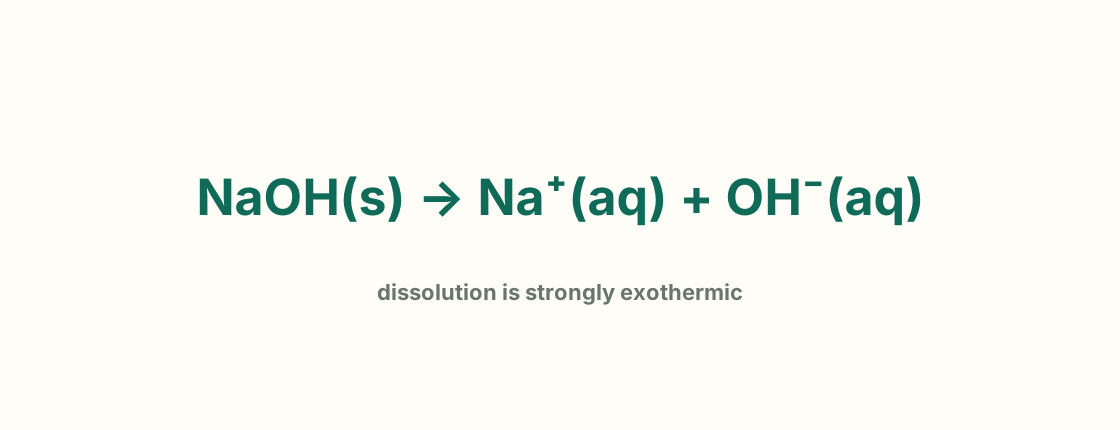
Breaking the ionic lattice costs energy, but hydration of the ions releases more under ordinary conditions, so the overall dissolution is exothermic.
When a strong acid and sodium hydroxide react in water, spectator ions can be removed from the equation. The core proton-transfer chemistry is hydronium plus hydroxide forming water.
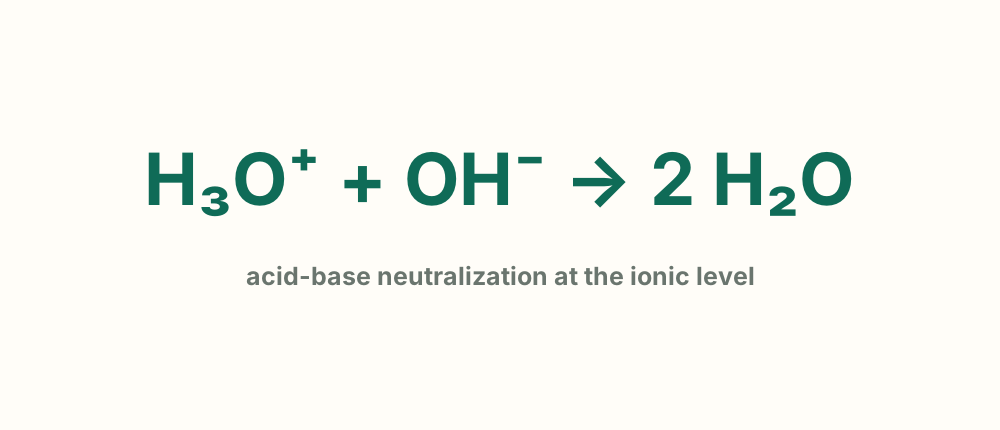
“Strong base” describes near-complete dissociation and acid–base behavior in water. A solution can still be dilute or concentrated independently of base strength.
| Formula | NaOH |
|---|---|
| CAS Registry Number | 1310-73-2 |
| PubChem CID | 14798 |
| Standard InChI | InChI=1S/Na.H2O/h;1H2/q+1;/p-1 |
| Canonical SMILES | [OH-].[Na+] |
That drawing suggests a discrete covalent molecule. The solid is ionic, and in water the relevant particles are solvated Na⁺ and OH⁻.
Ion hydration is strongly favorable. The net enthalpy change for dissolution is exothermic under ordinary conditions.
No. Aqueous hydroxide is strongly solvated and embedded in a fluctuating hydrogen-bond network. OH⁻(aq) is a compact chemical notation.