Polyatomic ion
OCl⁻ is the chemically active anion.
Its oxygen and chlorine remain covalently connected as one charged species.
Sodium hypochlorite is NaOCl, an ionic compound composed of Na⁺ and OCl⁻. The hypochlorite ion contains a covalent O–Cl bond and carries a −1 charge.
The formula balances +1 and −1 charges. Sodium is not covalently bonded into a three-atom Na–O–Cl molecule.
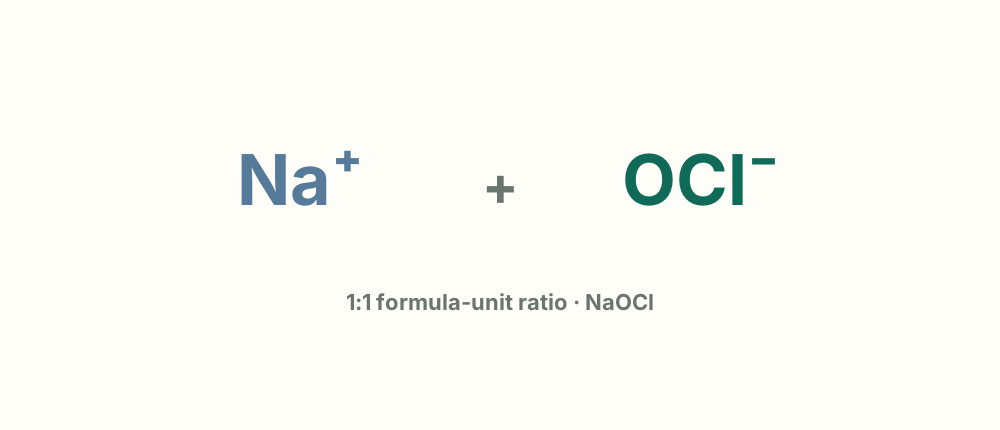
Its oxygen and chlorine remain covalently connected as one charged species.
Oxidation-state bookkeeping assigns oxygen −2, so chlorine is +1 in OCl⁻. That relatively high oxidation state is part of why hypochlorite can act as an oxidizing species.
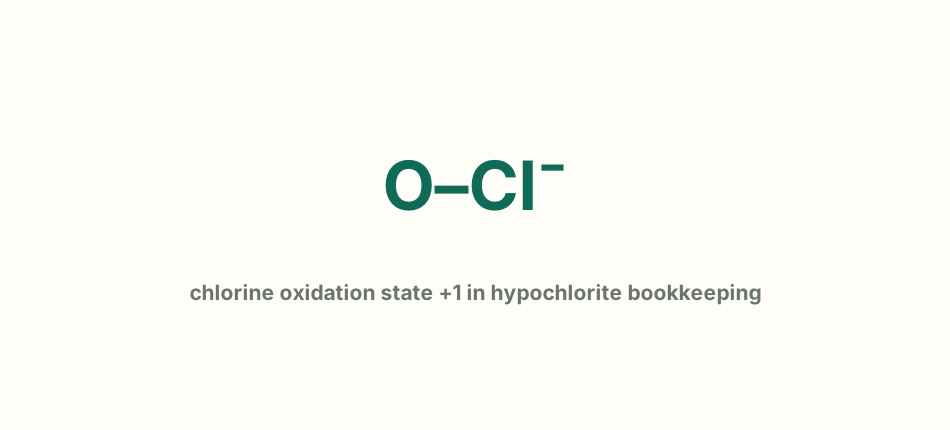
A two-atom species has a bond length but no three-atom bond angle to define.
Hypochlorite is the conjugate base of hypochlorous acid. Changing pH shifts the relative abundance of HOCl and OCl⁻ in water.
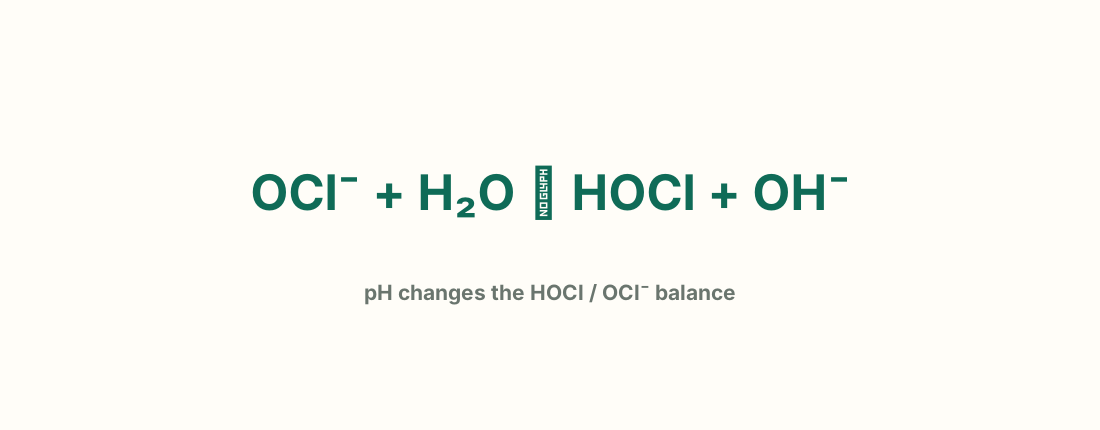
Acidification can generate hazardous chlorine-containing species; product safety instructions matter.
| Formula | NaOCl |
|---|---|
| CAS Registry Number | 7681-52-9 |
| Ions | Na⁺ and OCl⁻ |
No. Household bleach is an aqueous formulation containing hypochlorite and other components.
The compound is ionic; NaOCl is best treated as a formula unit made from Na⁺ and OCl⁻.
OCl⁻ and HOCl are a conjugate acid–base pair, so their relative proportions change with proton activity.