Mendeleev
Mendeleev / Compounds / Sulfur dioxide
Molecular compound · sulfur oxide

Sulfur dioxide

SO₂

Sulfur dioxide is SO₂, a bent molecular oxide. Its geometry prevents the two S–O bond dipoles from canceling, so SO₂ has a permanent molecular dipole.

Environmental context: atmospheric SO₂ participates in further oxidation and acidification chemistry.
Essentials

The first fact to see is that SO₂ is bent, not linear.

The beginner view needs shape before numerical detail.
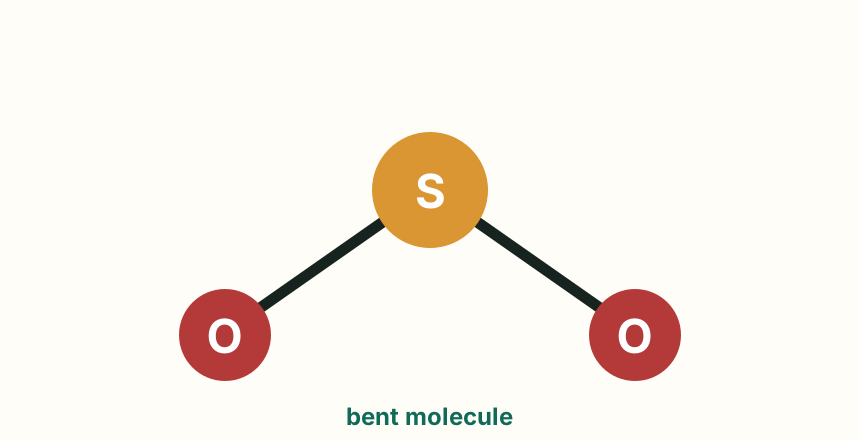
Simple bent sulfur dioxide with no angle value
Beginner view: SO₂ is bent.
Why shape matters

Bent geometry leaves a net molecular dipole.

The two polar S–O contributions do not cancel.

Detail

The gas-phase O–S–O angle is about 119.5°.

NIST experimental geometry gives a value close to 119.5°. The displayed value is rounded.
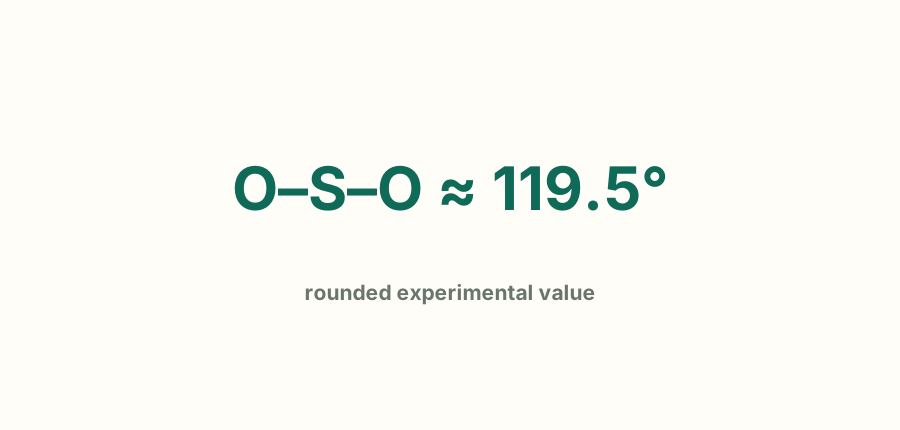
Sulfur dioxide O-S-O angle approximately 119.5 degrees
Detailed view: rounded experimental gas-phase angle.
Resonance

No single Lewis contributor permanently assigns one special S–O bond.

Electron density is delocalized across the S–O framework.

Read the formula

SO2 is a compact statement of composition.

Subscripts count atoms in the chemical molecule. Atom percentages and mass percentages answer different questions because the constituent elements have different atomic masses.

1 Ssulfur atom
2 Ooxygen atoms

Percentages are calculated from standard relative atomic masses and rounded for display.

Understand

SO₂ can be oxidized further to SO₃.

The balanced equation connects the two sulfur oxides; real pathways depend on catalysts or radical chemistry.
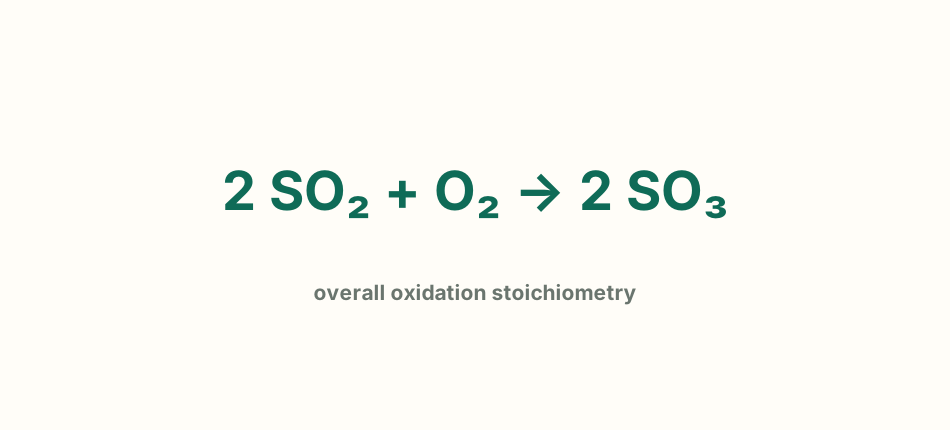
Sulfur dioxide oxidation to sulfur trioxide
Overall oxidation stoichiometry.
In water

Dissolved SO₂ participates in bisulfite/sulfite equilibria.

A single pure H₂SO₃ molecule picture is an oversimplification of the aqueous system.

Reference identifiers

Names and identifiers that pin down the chemical identity.

FormulaSO₂
CAS Registry Number7446-09-5
PubChem CID1119
Advanced

Push past the first model without losing the simple picture.

Why bent while CO₂ is linear?

Their valence-electron structures and central-atom electron domains differ.

Is the angle exactly 120°?

No. Experimental gas-phase SO₂ is about 119.5°.

Does SO₂ in water simply become H₂SO₃ molecules?

Aqueous sulfur(IV) chemistry is better described with dissolved SO₂ plus acid–base equilibria.

Constituent elements

Connect the compound back to the periodic table.