What diprotic means
Two protons can be transferred in separate steps.
Diprotic does not mean the two steps have the same equilibrium constant. H₂SO₄ and HSO₄⁻ are chemically different proton donors.
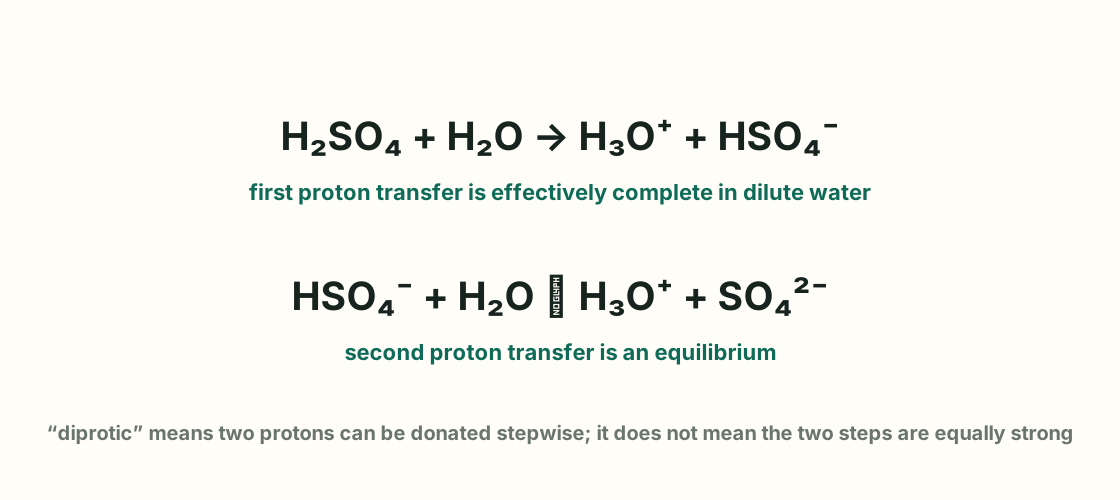
Sulfuric acid is H₂SO₄, a diprotic oxoacid of sulfur. In water it can donate two protons stepwise. The first proton transfer is extremely favorable; the second, from hydrogen sulfate, is a distinct equilibrium and should not be treated as identical.
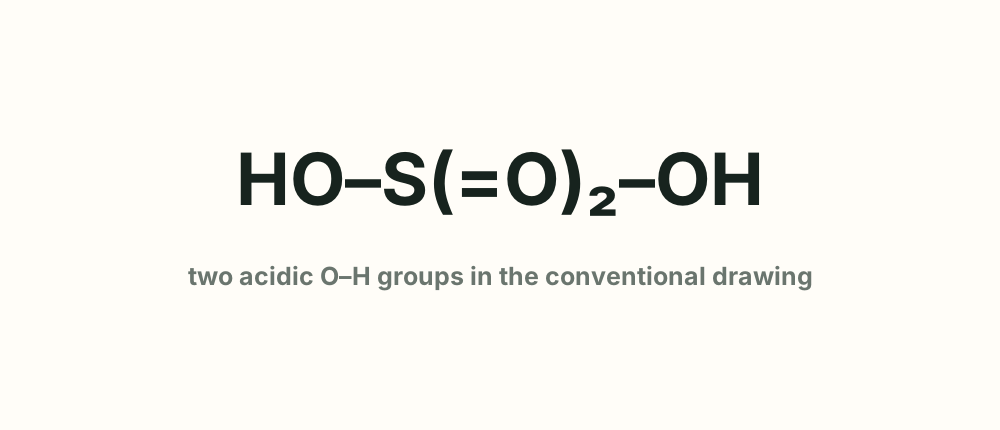
A common structural drawing, HO–S(=O)₂–OH, makes the two O–H groups visible. It is a useful bookkeeping representation, while more advanced bonding descriptions distribute electron density beyond a single Lewis picture.
Diprotic does not mean the two steps have the same equilibrium constant. H₂SO₄ and HSO₄⁻ are chemically different proton donors.
In dilute water the first proton transfer is effectively complete for ordinary introductory chemistry. Hydrogen sulfate can then donate a second proton, but this second step is a reversible equilibrium.
Depending on concentration, water activity and conditions, sulfuric-acid solutions contain water plus several protonation states and strongly solvated ions.
Hydration and ion formation release substantial heat. That thermal effect is a property of the mixing and ion-solvation process, not a visual feature of the H₂SO₄ formula itself.
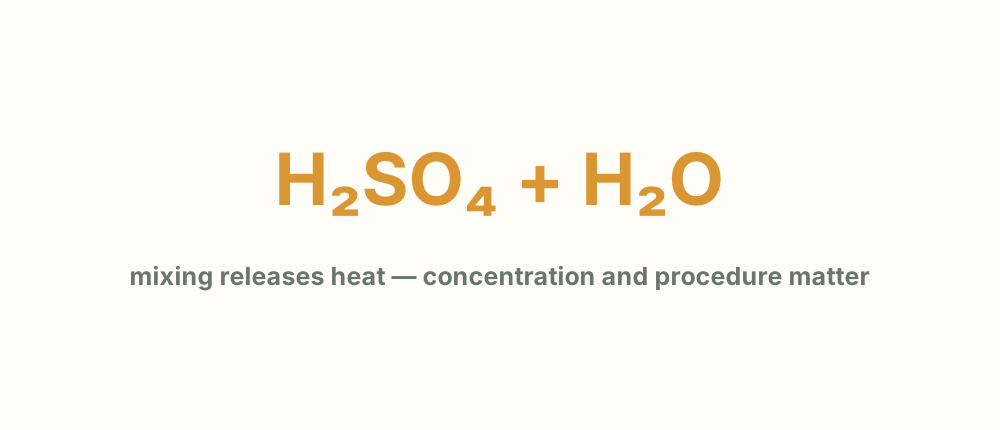
Because the mixing is highly exothermic, dilution procedure matters in laboratory practice. This page explains the chemistry rather than serving as an operating protocol.
| Formula | H₂SO₄ |
|---|---|
| CAS Registry Number | 7664-93-9 |
| PubChem CID | 1118 |
| Standard InChI | InChI=1S/H2O4S/c1-5(2,3)4/h(H2,1,2,3,4) |
| Canonical SMILES | OS(=O)(=O)O |
The familiar Lewis structure is useful for electron counting, but modern bonding descriptions involve substantial charge separation and delocalization. A single Lewis drawing should not be mistaken for a complete wavefunction-level description.
After the first proton is lost, the species is already negatively charged. Removing another proton creates a dianion, so electrostatic and solvation effects differ strongly from the first step.
No. At high concentration the solvent environment and speciation differ markedly from dilute aqueous acid; simple dilute-solution intuition becomes incomplete.