Linear symmetry changes the molecular polarity.
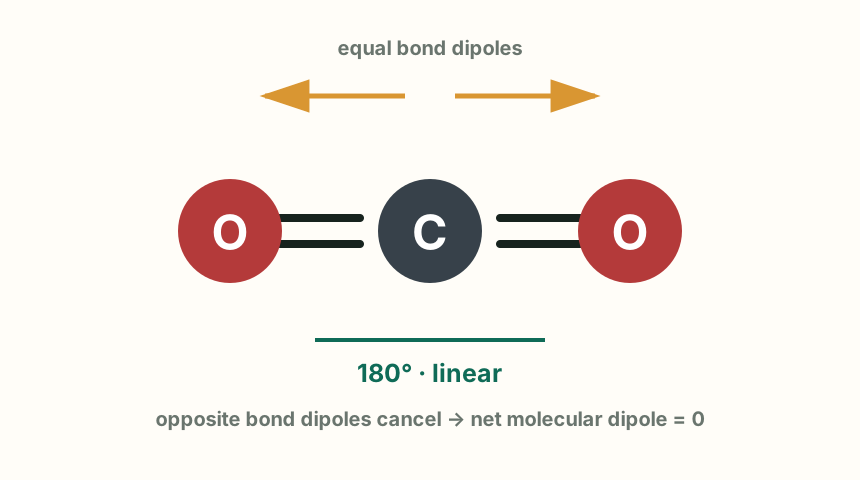
Each C=O bond is polar, but the molecule has two equivalent bonds pointing in opposite directions. Their dipole contributions cancel when the geometry is perfectly linear and symmetric.
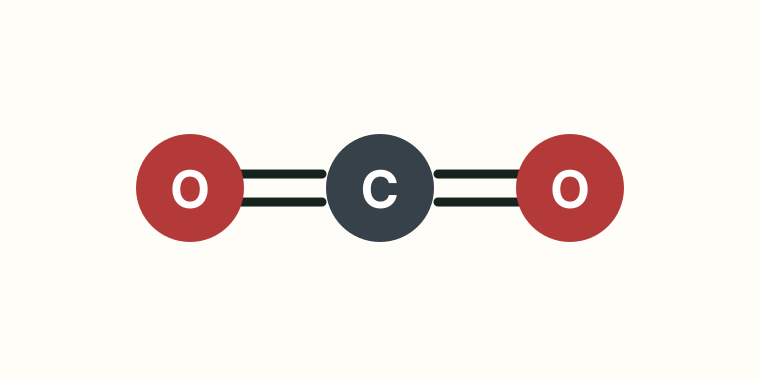
Carbon dioxide is a molecular compound containing one carbon atom and two oxygen atoms. Its O=C=O skeleton is linear. Each C=O bond is polar, but the two bond-dipole contributions oppose one another exactly in the ideal linear molecule, so CO₂ has no permanent molecular dipole.
One carbon atom lies between two oxygen atoms. For a first reading, that straight O=C=O arrangement is more important than any numerical angle or dipole notation.
Each C=O bond is polar, but the molecule has two equivalent bonds pointing in opposite directions. Their dipole contributions cancel when the geometry is perfectly linear and symmetric.
The 180° angle describes the linear molecular geometry. The molecule has polar bonds but no permanent molecular dipole because the two equal bond-dipole vectors are opposite.
A bond describes unequal electron sharing between two atoms. Molecular polarity depends on the vector sum of all bond dipoles and therefore on geometry as well as bond polarity.
One carbon atom is paired with two oxygen atoms in each molecule. The formula gives composition; the O=C=O structural formula adds connectivity and bond multiplicity.
CO₂ can dissolve physically in water. A smaller fraction reacts with water to form carbonic acid, and carbonic acid can participate in acid–base equilibria. Writing every dissolved CO₂ molecule as H₂CO₃ overstates the extent of hydration.
This compact sequence shows chemical relationships, not equal concentrations of all species.
CO₂ has vibrational modes that temporarily change its dipole distribution. Its asymmetric stretch and bending vibrations are infrared-active; the perfectly symmetric stretch does not create the same changing dipole. This distinction matters in spectroscopy and atmospheric physics.
At carbon, the two C=O bonding directions arrange opposite one another in the equilibrium molecule. In valence-bond shorthand this is often described with sp hybridisation; molecular-orbital descriptions reach the same observed linear geometry without requiring hybrid orbitals as physical objects.
No. Zero permanent dipole is not zero polarizability. An external field can distort the electron distribution and induce a dipole.
No. Solid carbon dioxide contains CO₂ molecular units packed in a crystal. Sublimation changes the physical state, not the molecular formula.
| Molecular formula | CO₂ |
|---|---|
| Molar mass | 44.0095 g/mol |
| CAS Registry Number | 124-38-9 |
| PubChem CID | 280 |
| Standard InChI | InChI=1S/CO2/c2-1-3 |
| Equilibrium molecular geometry | Linear O=C=O; 180° |