Mendeleev
Mendeleev / Compounds / Water
Molecular compound · oxygen hydride

Water

H₂O

Water is a molecular compound made from two hydrogen atoms and one oxygen atom. The molecule is bent rather than linear. That geometry, together with polar O–H bonds, gives water a molecular dipole and underlies much of its intermolecular chemistry.

Everyday distinction: “water” can refer to a pure chemical substance or to a real sample containing dissolved ions, gases and other substances. H₂O is the chemical identity of the water molecules themselves.
Essentials

The first fact to get right: H₂O is bent.

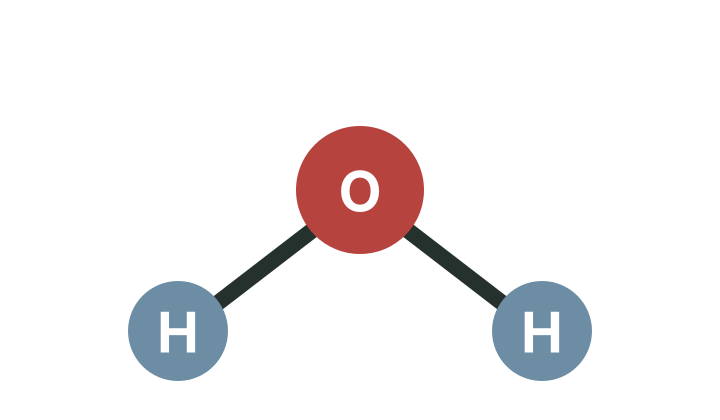
The three atoms in a water molecule are not arranged in a straight line. Oxygen sits at the vertex of a bent H–O–H shape. That simple piece of geometry is enough for a first reading; the numerical angle belongs one level deeper.

Simple bent H2O molecule without angle labels
Beginner view: the water molecule is bent. No angle value or electron-pair notation is needed to understand this first idea.
Why the shape matters

Bent geometry lets the bond dipoles add instead of cancel.

Each O–H bond is polar because oxygen attracts the bonding electrons more strongly than hydrogen. Because the two bonds point in different directions rather than directly opposite one another, their dipole contributions do not cancel. Water therefore has a net molecular dipole.

Compare: carbon dioxide has polar C=O bonds, but its linear and symmetric geometry makes the two bond-dipole contributions cancel.
Geometry in detail

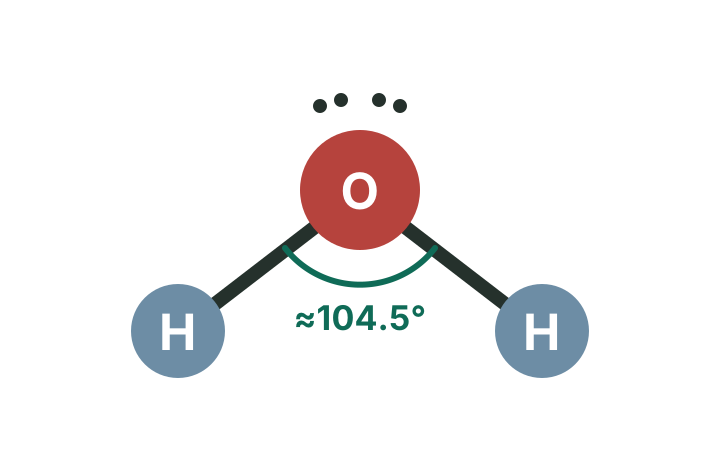
How bent? The gas-phase H–O–H angle is about 104.5°.

The angle is measured at oxygen between the two O–H bond directions. Experimental gas-phase data give an equilibrium angle very close to 104.5°. The symbol ≈ is deliberate: 104.5° is a rounded experimental value, not a mathematical constant for every instantaneous water geometry in every environment.

Bent H2O molecule with an arc showing an H-O-H angle of approximately 104.5 degrees and two lone pairs on oxygen
Detailed view: the arc marks the H–O–H bond angle. The four small dots represent the two lone pairs on oxygen.
What this number means

≈104.5° describes an isolated gas-phase molecule.

It is the angle between the two O–H bonds at oxygen. It should not be interpreted as a fixed angle between neighbouring molecules in liquid water. In the liquid, hydrogen bonding and molecular motion continually perturb local geometries.

Why not 109.5°? A tetrahedral electron-domain picture is a useful starting model, but lone-pair electron density changes the equilibrium molecular geometry. The measured H–O–H angle is smaller.
Read the formula

H₂O is a compact statement of composition.

The subscripts count atoms in one molecule: two H atoms for every one O atom. The mass percentages look very different from the atom percentages because oxygen atoms are much heavier than hydrogen atoms.

2 Hhydrogen atoms
1 Ooxygen atom

Percentages by mass use standard atomic-weight values and are rounded for display.

Intermolecular chemistry

Hydrogen bonds connect water molecules without turning them into one giant molecule.

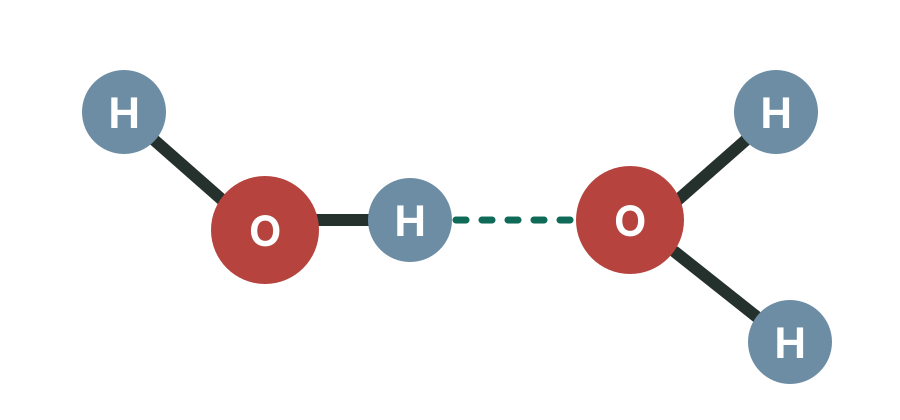
An O–H bond inside one H₂O molecule is covalent. A hydrogen bond is an attractive intermolecular interaction involving the hydrogen of an O–H group and an electron-rich site on another molecule. Keeping those two bond types separate prevents a common conceptual error.

Two separate water molecules with one dashed hydrogen bond from hydrogen to oxygen
One dashed H···O contact represents the intermolecular hydrogen bond. Solid O–H lines remain covalent bonds within two separate water molecules.
Structure → properties

Why hydrogen bonding matters

Water molecules can both donate and accept hydrogen bonds. The resulting network changes continuously in the liquid, yet it strongly influences boiling, surface behaviour, solvation and the structures adopted by ice.

These are collective properties of many interacting molecules; they cannot be inferred from a single H₂O formula alone.

Acid–base chemistry

Water can act as an acid or as a base.

Proton transfer between water molecules produces hydronium and hydroxide ions. The equilibrium lies very far toward neutral water under ordinary conditions, but it is chemically fundamental.

2 H₂O ⇌ H₃O⁺ + OH⁻
Advanced

Push past the textbook shortcuts.

Why is the H–O–H angle not 109.5°?

A tetrahedral electron-domain picture is a useful starting model, but lone-pair electron density and the details of the molecular wavefunction alter the equilibrium geometry. Experiment gives an angle close to 104.5° for gas-phase H₂O.

Is a hydrogen bond purely electrostatic?

Electrostatics are important, but modern descriptions also include polarization and orbital contributions. “Partial charges attract” is useful at introductory level, not a complete quantum-mechanical account.

Does every water molecule always have four hydrogen bonds?

No. Four is a useful tetrahedral-network motif, especially in ice and local liquid structures, but the liquid network fluctuates continuously and individual molecules do not carry a permanently fixed set of four hydrogen bonds.

Reference identity

Water as a chemical substance.

Molecular formulaH₂O
Molar mass18.0153 g/mol
CAS Registry Number7732-18-5
PubChem CID962
Standard InChIInChI=1S/H2O/h1H2
Molecular geometryBent; experimental H–O–H angle ≈104.5° in the gas phase
Constituent elements

Hydrogen and oxygen become water only through a particular bonding arrangement.