Formula unit
Why chemists still write NaCl.
Electrical neutrality requires equal numbers of Na⁺ and Cl⁻ ions. The smallest whole-number ratio is therefore 1:1, which is written NaCl as a formula unit.
Sodium chloride is an ionic compound built from Na⁺ and Cl⁻ ions in a 1:1 ratio. In a solid crystal, NaCl is not best described as a collection of separate NaCl molecules. The formula is a formula unit: the simplest whole-number ratio of sodium to chloride ions in the extended lattice.
The formula expresses a 1:1 ratio of sodium ions to chloride ions in an extended crystal lattice. A simple repeating pattern communicates that idea better than drawing one isolated Na–Cl pair.
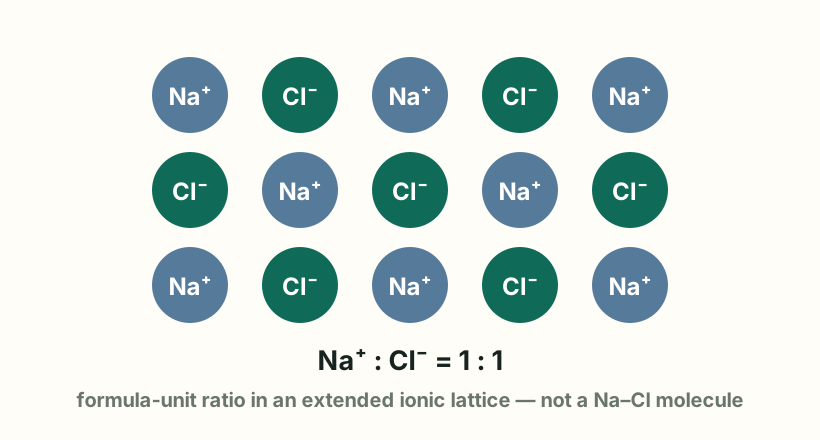
Electrical neutrality requires equal numbers of Na⁺ and Cl⁻ ions. The smallest whole-number ratio is therefore 1:1, which is written NaCl as a formula unit.
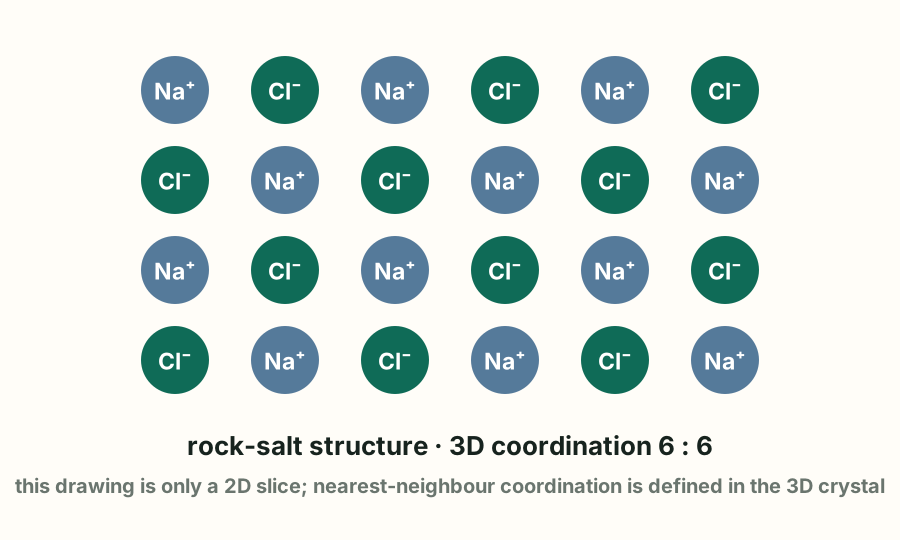
A flat drawing can only show a slice. In the three-dimensional crystal each Na⁺ has six nearest Cl⁻ neighbours, and each Cl⁻ has six nearest Na⁺ neighbours.
The formula unit contains one sodium for one chlorine. In the solid these atoms are present as ions, Na⁺ and Cl⁻, arranged throughout the lattice.
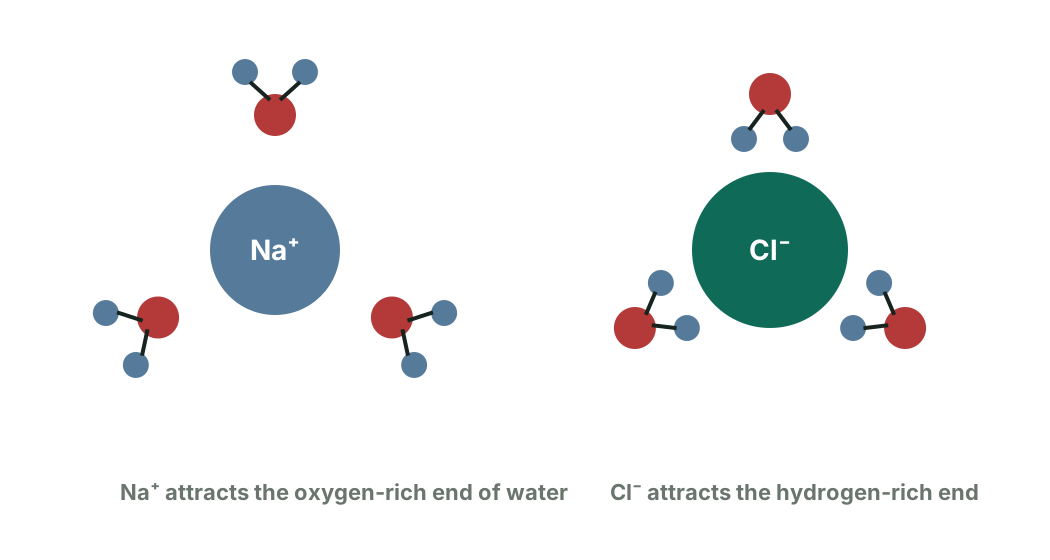
Water's polar molecules stabilise separated ions. Around Na⁺, the oxygen-rich end of water tends to orient inward; around Cl⁻, the hydrogen-rich end tends to orient inward. Dissolution competes with the strong electrostatic attractions holding the ionic lattice together.
In solid NaCl the ions occupy lattice positions and cannot transport charge freely through the crystal. When molten, or when dissolved so the ions can move through a solution, Na⁺ and Cl⁻ can carry electric current.
Poor electrical conduction under ordinary conditions.
Charge can be transported by moving Na⁺ and Cl⁻.
Dissolved ions move through the solvent and conduct.
The rock-salt structure can be described as two interpenetrating face-centred cubic sublattices, or as one face-centred cubic ion lattice with the octahedral sites occupied by the other ion. The local nearest-neighbour geometry is octahedral, giving coordination number six for both ions.
“Ionic” is a highly useful structural and bonding classification, but real electron density is not divided by an absolute boundary. Modern bonding analyses can quantify partial covalent contributions while the bulk compound remains correctly classified as an ionic solid.
Dissolution depends on the overall free-energy change. Separating ions costs lattice energy; ion–water interactions and entropy can compensate. Solubility cannot be predicted from a single attraction alone.
| Formula | NaCl |
|---|---|
| Molar mass | 58.44 g/mol |
| CAS Registry Number | 7647-14-5 |
| PubChem CID | 5234 |
| PubChem SMILES | [Na+].[Cl-] |
| Solid structure | Rock-salt type; 6:6 nearest-neighbour coordination |