Ketohexose
Fructose
C₆H₁₂O₆ with the open-chain ketone at C2.
Fructose is a monosaccharide and a ketohexose. Its molecular formula is exactly the same as glucose, C₆H₁₂O₆, but its atoms are connected differently. In the open-chain description fructose has a ketone carbonyl at C2, whereas glucose is an aldose with its carbonyl at C1.
Isomers can contain the same numbers of each atom while differing in connectivity or spatial arrangement. Fructose and glucose are constitutional isomers: their carbonyl functions occupy different positions in the open-chain structures.
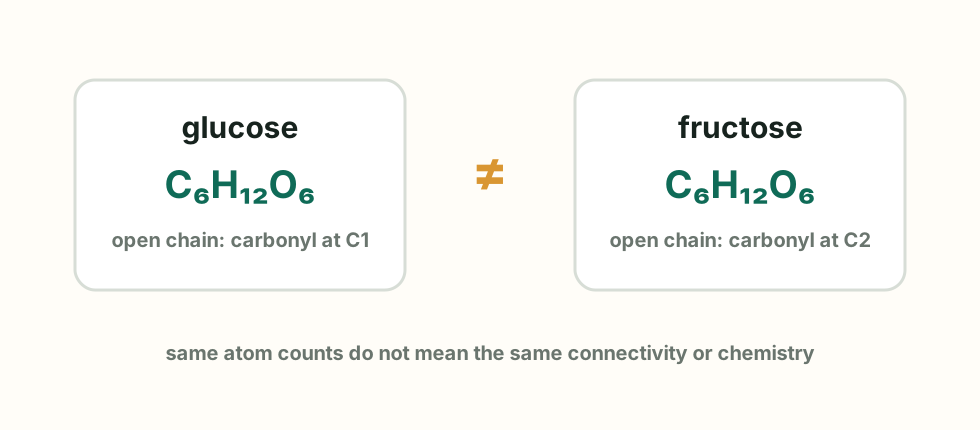
The atom counts are identical to glucose: 6 carbon, 12 hydrogen and 6 oxygen atoms. The different chemistry comes from structure, not composition.
The open-chain representation makes the classification easiest to see. IUPAC uses “ketoses” for ketonic parent sugars and their cyclic intramolecular hemiacetal/hemiketal forms; in fructose the oxo group is at C2.
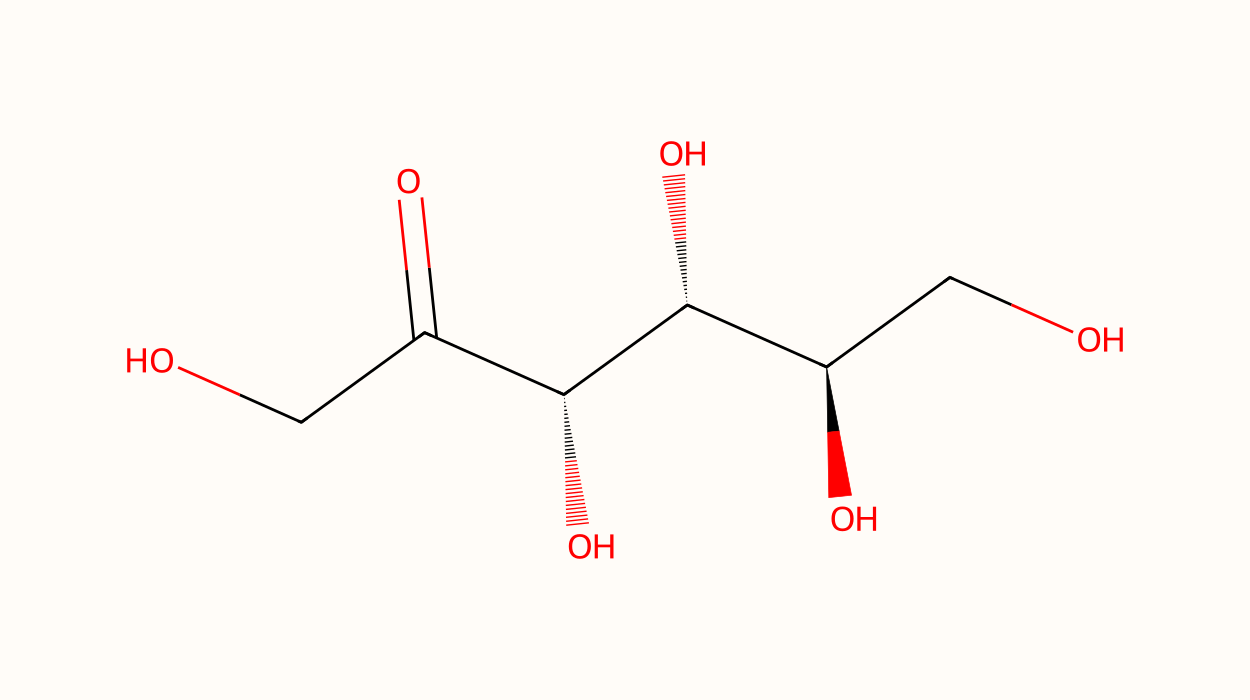
Fructose can cyclise intramolecularly and may occur in five-membered and six-membered ring forms as well as a linear form. The exact distribution depends on environment. The open-chain drawing remains especially useful because it shows why fructose is classified as a ketose.
In sucrose, the fructose residue participates through its anomeric carbon C2 in the glycosidic linkage to the glucose residue. Free fructose and fructose inside sucrose are therefore related but not interchangeable descriptions.
See how the glucose and fructose units are connected and why sucrose is nonreducing.
“Reducing sugar” behaviour is not limited to compounds drawn as aldehydes. Under relevant solution conditions, ketoses such as fructose can enter equilibria that generate aldose-type species capable of reducing common test reagents.
Different hydroxyl groups can attack the C2 carbonyl intramolecularly, producing ring closures of different sizes. The resulting equilibria are sensitive to stereochemistry and solvent conditions.
No. It identifies a molecular formula. Glucose, fructose and galactose are examples of distinct compounds that share this formula.
| Molecular formula | C₆H₁₂O₆ |
|---|---|
| Molar mass | 180.1559 g/mol |
| CAS Registry Number | 57-48-7 |
| PubChem CID | 5984 |
| Standard InChIKey | BJHIKXHVCXFQLS-UYFOZJQFSA-N |
| Open-chain class | Ketohexose; carbonyl at C2 |
C₆H₁₂O₆ with aldehyde-derived carbonyl chemistry in the open-chain form.
C₆H₁₂O₆ with the open-chain ketone at C2.
A glucose unit and a fructose unit joined through a glycosidic bond.