1875
Gallium
Mendeleev’s “eka-aluminium” was meant to occupy the place below aluminium. When gallium was isolated, its chemistry and several measured properties closely matched the profile he had set out for the missing element.
Mendeleev did not invent the idea of grouping similar elements. His decisive contribution was to turn periodicity into a working system: broad enough to organize the known elements, flexible enough to correct doubtful data, and bold enough to leave spaces for elements that chemistry had not yet found.
By the 1860s, chemists knew more than sixty elements and had several competing ways to arrange them. Döbereiner had identified triads; de Chancourtois had wrapped the elements around a cylinder; Newlands had noticed recurring similarities; Lothar Meyer had organized families and related atomic volume to atomic weight. Mendeleev worked in that same scientific landscape.
What made his 1869 periodic system unusually productive was the way he treated gaps and inconsistencies. If an element seemed to sit in the wrong chemical family, he was prepared to question the accepted atomic weight. If a sequence demanded an element that no one had isolated, he left a space rather than forcing the pattern to close.
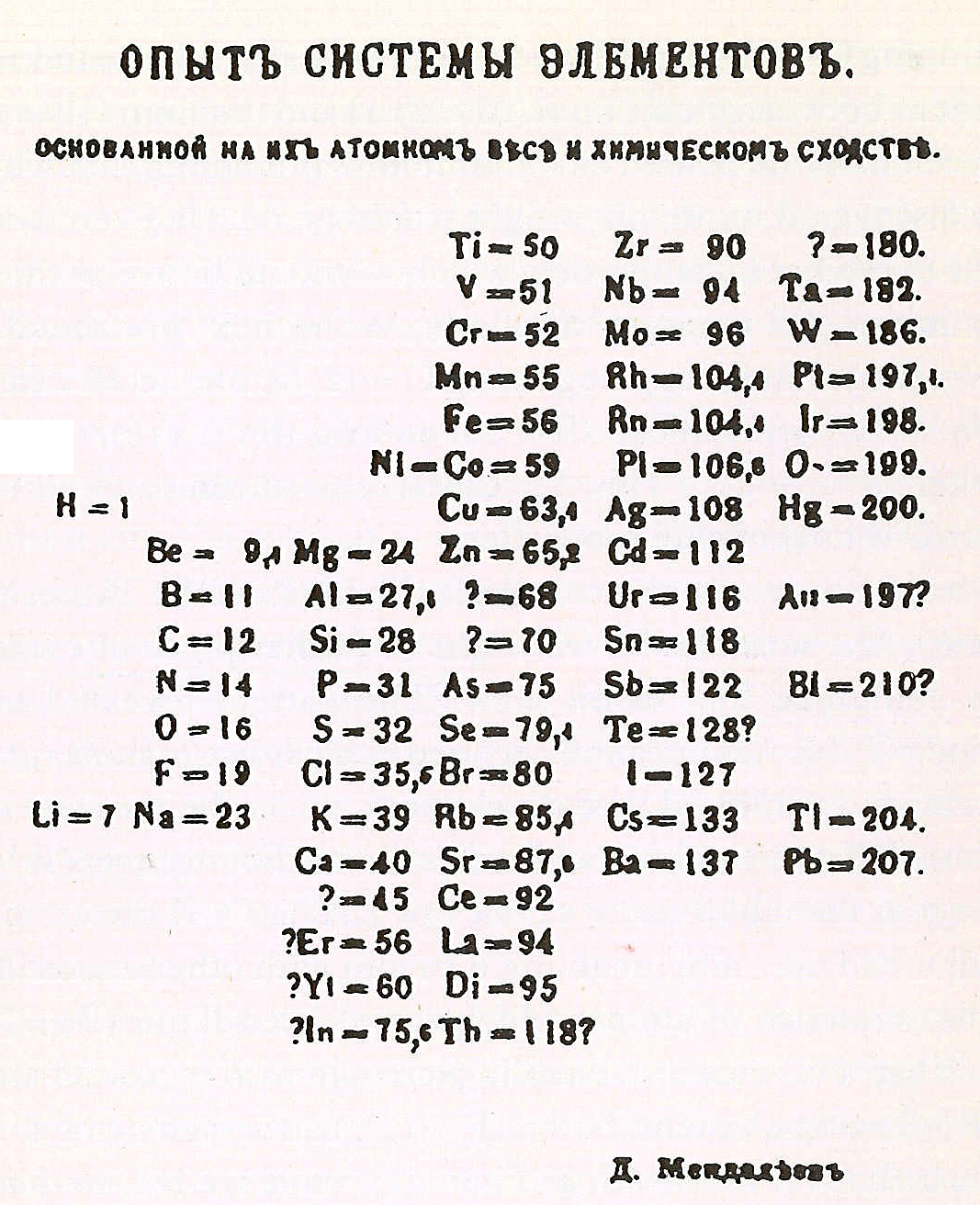
Mendeleev’s “eka-aluminium” was meant to occupy the place below aluminium. When gallium was isolated, its chemistry and several measured properties closely matched the profile he had set out for the missing element.
Scandium filled the position associated with “eka-boron.” Its oxide and chemical behaviour strengthened the case that the empty positions reflected real structure in the elements, not merely a neat way to print a list.
Germanium supplied the most celebrated confirmation. Mendeleev had described “eka-silicon” in enough detail that the comparison could be made across atomic weight, density and characteristic compounds.
In 1867 Mendeleev became professor of general chemistry at the University of St Petersburg. While preparing Principles of Chemistry, he needed a coherent way to move from one family of elements to the next. The periodic system grew inside that practical task: arranging a large body of chemical facts so that relationships became visible instead of being memorized separately.
The Karlsruhe Congress of 1860 also mattered. Work associated with Stanislao Cannizzaro helped clarify atomic weights, giving chemists a more consistent numerical basis for comparison. Mendeleev’s system still used atomic weight rather than atomic number, but it combined numerical order with chemical properties rather than treating the numbers as an inflexible ranking.
The modern table is not Mendeleev’s table frozen in place. Noble gases added an entire family. Radioactivity and the rare-earth elements complicated the late nineteenth-century picture. In 1913 Henry Moseley showed that atomic number, not atomic weight, provides the correct ordering principle. Quantum mechanics later explained periodicity in terms of electron structure.
Those changes did not erase the periodic law. They gave it a firmer physical basis. The modern arrangement by proton number, and the recurring patterns produced by electron configurations, preserve the central insight that made Mendeleev’s system powerful: position in the table carries information about chemical behaviour.
History is easiest to see when the grid changes. Move from 1869 to 1875, 1879 and 1886 and watch the predicted positions become discovered elements.
Open the historical periodic table →